
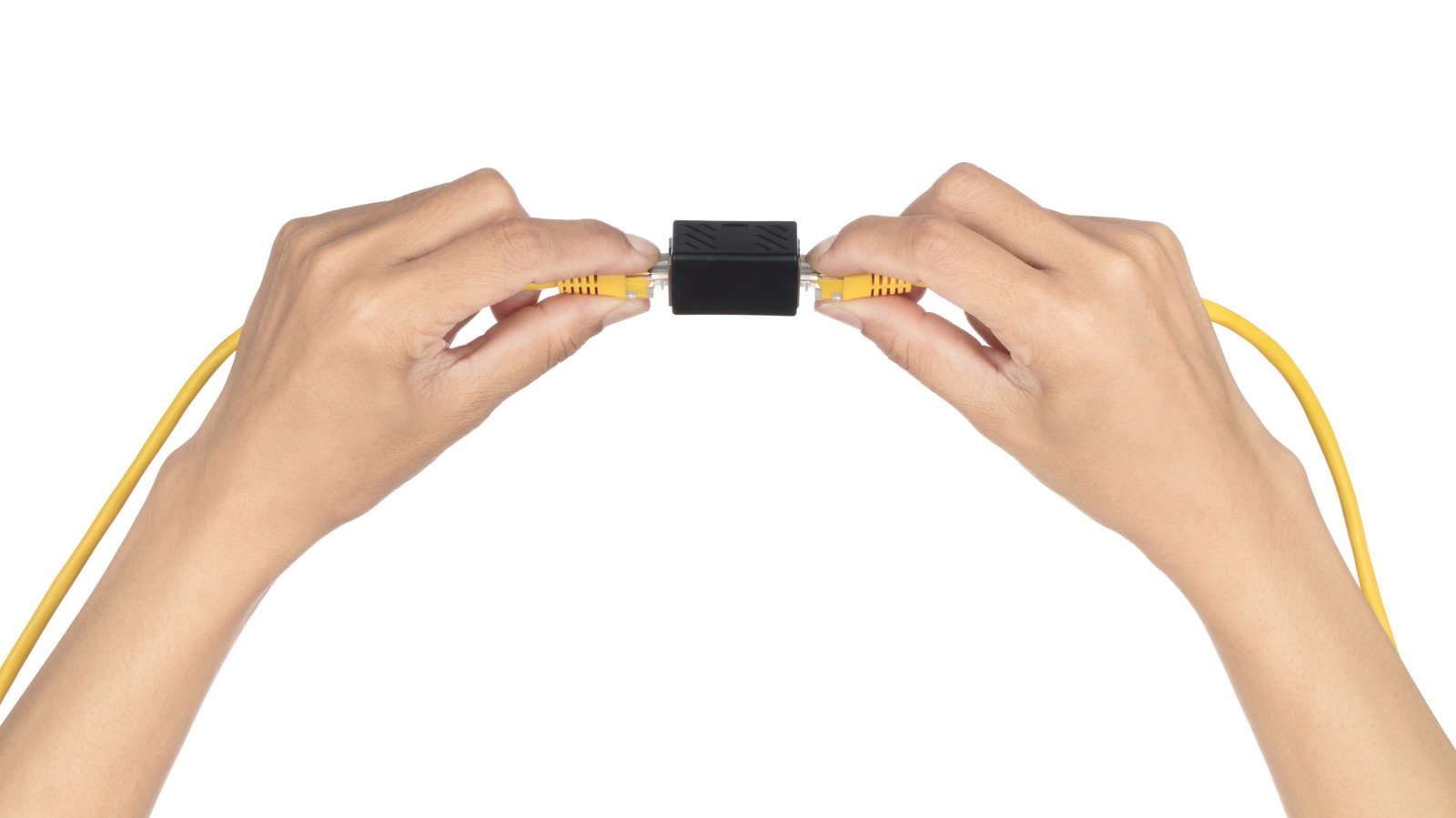
Ethernet Coupler Failures Threaten Home Network Speed
Rearranging a home workspace often leaves a vital Ethernet cable just inches short of reaching the back of a desktop or gaming console. When faced with this minor hardware dilemma, many users grab a cheap Ethernet coupler to bridge the gap between two shorter cords. Although this basic plastic adapter requires no external power or difficult software configuration, it introduces an unnecessary physical failure point. Instead of achieving a seamless link, plugging two cables together can instantly degrade high-speed data transmission across your local area network.
Hardware testing conducted by trueCABLE reveals that stacking multiple couplers on standard Cat6 lines quickly leads to severe signal degradation and total packet loss. While a single adapter might occasionally pass basic continuity tests, every added connection point invites signal reflection and interference. Because of this, standard copper cable limits of 328 feet remain strictly enforced by physics. An adapter cannot reset or extend maximum channel lengths, meaning long runs joined together frequently drop from gigabit speeds down to 100 Mbps.
Why Hidden Connection Points Cause Speed Drops
Behind the walls or underneath office furniture, a poorly joined wire creates frustrating intermittent dropouts that mimic router failures. That said, troubleshooting slow internet speeds should always begin by inspecting physical patch cords before calling your internet service provider. Network performance suffers tremendously when inferior adapters are subjected to daily foot traffic, desk vibrations, or tight bends behind entertainment centers.
- Single long cables eliminate vulnerable connection joints and extra hardware overhead.
- Network switches provide reliable multi-port expansion without degrading signal integrity.
- Standard Cat5e or Cat6 cables easily handle gigabit speeds when properly routed.
That said, replacing an entire hidden wire after a lengthy installation is rarely practical when you simply need extra ports for a smart TV or streaming box. Rather than splicing raw lines together, installing an unmanaged network switch properly distributes bandwidth to multiple devices without compromising your primary data stream.
The Bottom Line on Permanent Wiring Alternatives
Achieving a reliable, high-speed connection requires mindful planning rather than quick physical fixes. Although an Ethernet coupler offers an attractive temporary solution for a misplaced desk, permanent setups demand dedicated single-run cables or powered switches. By eliminating unnecessary mechanical junctions, you ensure your local hardware runs at peak performance without frustrating dropouts.
Ethernet Coupler Market Impact and Industry Significance
The introduction of Ethernet Coupler represents a pivotal shift in modern technological adoption across enterprise and consumer sectors alike. Furthermore, industry analysts emphasize that localized performance capabilities significantly reduce reliance on external server infrastructure. Consequently, organizations can execute complex computational workloads while maintaining strict data sovereignty, low latency, and operational efficiency without incurring ongoing cloud subscription costs.
Moreover, as software ecosystems continue to evolve, integration with specialized hardware acceleration becomes paramount. Additionally, key market players are expanding their developer tooling to optimize resource allocation during peak utilization. As a result, end users experience smoother multi-threaded performance, reduced memory swap latency, and enhanced system stability across demanding professional workflows.
Performance Benchmarks and Practical Ethernet Coupler Scenarios
In real-world deployment scenarios, evaluating sustained throughput and thermal efficiency is essential for technical decision-makers. Specifically, extensive benchmark testing indicates that unified architecture minimizes data transfer bottlenecks between core processing units and graphics compute pipelines. Therefore, demanding tasks operate with minimal compute overhead.
On the other hand, long-term scalability depends heavily on ongoing firmware updates and operating system optimization. Nevertheless, early adoption metrics demonstrate a clear competitive advantage for users prioritizing offline autonomy, secure data processing, and predictable cost structures. Ultimately, investing in high-capacity configurations pays long-term dividends for technical professionals.