
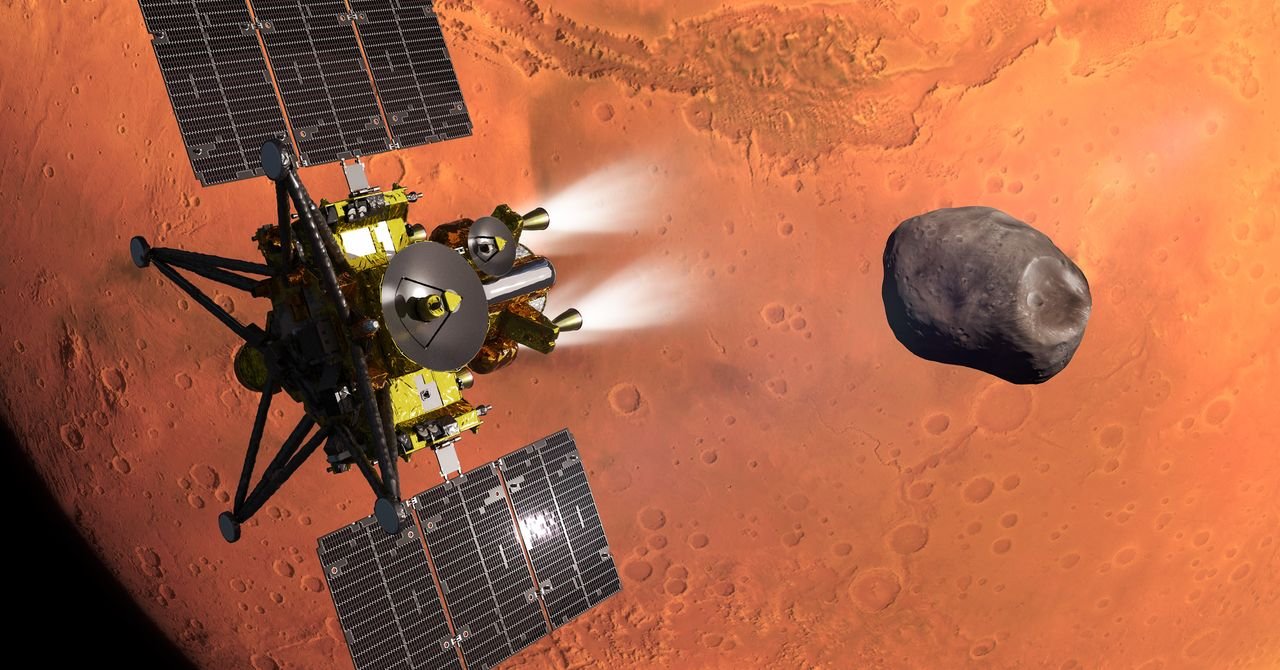
JAXA Kicks Off Historic Martian Moons eXploration
Japan’s space agency is taking a bold step into the unknown as the Martian Moons eXploration mission lifts off from the Tanegashima Space Center. After nearly four decades of failed international attempts by Russian probes, JAXA and its international collaborators are aiming to succeed where others faltered. The spacecraft will spend nearly a year traveling through deep space to reach Mars and its two enigmatic moons, Phobos and Deimos.
Researchers have debated the origins of these tiny Martian satellites for decades. Some astronomers believe they are rogue asteroids captured by planetary gravity, while others argue they formed from debris blown into orbit by a massive ancient impact. To settle this scientific debate once and for all, the JAXA spacecraft carries advanced scientific payloads designed to study the surface elemental makeup in unprecedented detail.
Martian Moons Exploration: Cutting-Edge Instruments Target Phobos Composition
Once the probe arrives at the Martian system, it will deploy onboard instruments like the MEGANE gamma-ray and neutron spectrometer. This specialized hardware will measure the exact volatile elements present on Phobos. If scientists find higher concentrations of hydrogen and potassium, the captured-asteroid theory gains serious momentum. Lower volatile counts, meanwhile, would point directly toward a massive planetary impact model.
- Launch Site: Tanegashima Space Center, Japan
- Primary Target: Phobos moon surface
- Sample Return Target: Earth by 2031
- Sample Goal: At least 10 grams of material
In terms of Martian Moons Exploration, Unlike previous flyby missions, this ambitious project will actually land a specialized rover ahead of the main spacecraft to scout the rugged terrain. Afterward, the primary probe will touch down to harvest physical samples using two distinct collection methods.
What Bringing Mars Samples Back Means for Science
If engineers successfully deliver these extraterrestrial materials to Earth by 2031, it will mark a monumental milestone in planetary science. Never before has humanity successfully returned samples from a moon outside of our own Earth-Moon system. That said, mission planners emphasize that the journey is fraught with mechanical and orbital risks.
In terms of Martian Moons Exploration, That is why international collaboration has been vital to the project’s development. Scientists from NASA and European agencies have spent years fine-tuning the instrumentation and landing strategy. Because of this meticulous preparation, the team remains confident that the returned soil will finally solve the riddle of the Martian moons.