
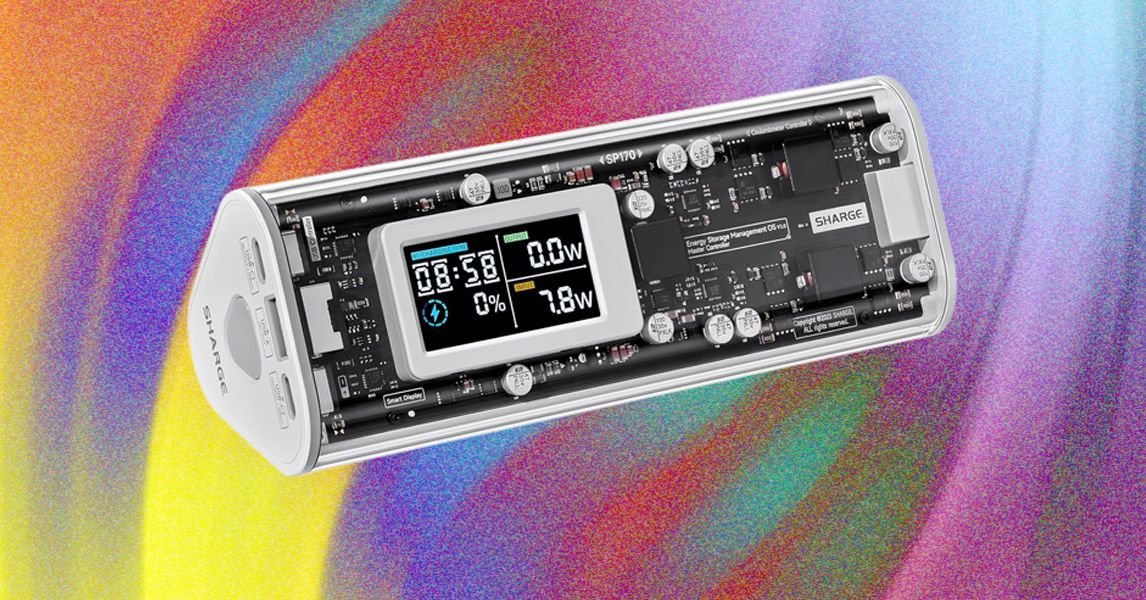
Technical Specifications and Architectural Breakdown
The engineering challenge inherent in a high-capacity laptop power bank lies in the delicate equilibrium between total energy storage and power delivery efficiency. Anker’s latest 25,000-mAh model excels by utilizing high-density lithium-polymer cells that maintain stability under sustained high-wattage loads. The unit is capable of delivering a total output of 165 watts, with a single USB-C port capable of pushing 100 watts of Power Delivery (PD) 3.0. This is sufficient to fast-charge a MacBook Air, a high-end Dell XPS, or a modern Chromebook without the throttling issues common in lower-tier chargers.
Central to this device’s success is its sophisticated power management integrated circuit (PMIC). Unlike generic chargers that rely on basic voltage regulation, this unit employs a smart control system that monitors thermal dissipation and current fluctuations in real-time. The integration of a high-resolution OLED display represents a significant departure from the opaque, four-dot LED indicators found on legacy hardware. This display provides granular data, including exact remaining capacity, current wattage draw, and real-time internal temperature metrics. By providing this transparency, the user can diagnose power bottlenecks—such as a faulty cable or an inefficient peripheral—before they result in unexpected downtime.
Industry Landscape and Competitive Comparison
The market is currently flooded with generic power banks that promise high capacity but fail to deliver the necessary output voltage to sustain a laptop under load. Many of these units rely on outdated charging protocols that result in “trickle charging,” where the laptop consumes power faster than the bank can supply it. When evaluating a laptop power bank, the primary metrics must be the sustained output wattage and the protocol compatibility (specifically PD 3.0 or PPS support).
| Feature | Anker 25k mAh Unit | Generic 20k mAh Bank | Legacy 20k mAh Bank |
|---|---|---|---|
| Max Total Output | 165W | 45W | 30W |
| Single Port PD | 100W | 30W | 18W |
| Display Type | Smart OLED | LED Dots | None |
| Efficiency Rating | High (90%+) | Moderate (75%) | Low (60%) |
As illustrated by the data, the discrepancy between premium engineered solutions and generic alternatives is stark. While a generic 20,000-mAh bank may seem sufficient on paper, its inability to provide more than 45 watts means it will struggle to charge a laptop that is actively in use. The Anker unit’s ability to sustain 100 watts allows it to act as a true mobile workstation power supply, effectively bridging the gap between desktop connectivity and field portability.
Practical Consumer & Enterprise Takeaways
For the enterprise user, the decision to invest in a high-capacity laptop power bank is a matter of calculating the cost of downtime. If a field technician or consultant loses an hour of productivity due to a drained battery, the cost of that hour often exceeds the price of the charger itself. When selecting a unit, professionals should prioritize units that support PPS (Programmable Power Supply), as this allows the charger to adjust voltage dynamically, reducing heat and extending the lifespan of the laptop’s internal battery.
Furthermore, weight and size remain critical factors. At 25,000 mAh, this unit sits at the upper limit of what is permitted for air travel under TSA regulations (the 100Wh limit). Users should be aware that while this capacity is ideal for long-haul travel, exceeding this limit can lead to confiscation at security checkpoints. The cost-benefit trade-off favors units that offer high-wattage output over those that prioritize sheer capacity, as a 10,000-mAh charger that cannot provide 60W is effectively useless for a modern professional laptop.
Frequently Asked Questions
Is this power bank safe to carry on commercial aircraft? Yes, the 25,000-mAh capacity falls within the standard 100Wh limit mandated by most international aviation authorities. However, it is essential to keep the device in your carry-on luggage, as lithium-ion batteries are prohibited in checked baggage due to fire safety risks.
Does the smart display consume significant battery life? The OLED display is highly efficient and is designed to time out after a few seconds of inactivity. The power consumption of the screen is negligible compared to the total energy capacity of the unit, and the diagnostic utility it provides outweighs the minor energy draw.
Can I charge multiple devices simultaneously without losing laptop charging speed? The unit uses intelligent power distribution. When multiple ports are occupied, the total wattage is split. To maintain the full 100W output for a laptop, it is recommended to keep other ports vacant or use only low-power devices like smartphones in the auxiliary ports.
The Bottom Line
The requirement for reliable, high-wattage portable energy is no longer a niche concern; it is a fundamental aspect of the digital workspace. By prioritizing output wattage, thermal management, and user-facing diagnostics, the Anker 25,000-mAh power bank establishes a clear lead over generic market incumbents. It provides the necessary power to keep high-performance hardware running in environments where wall outlets are unavailable. For professionals who require a dependable, transparent, and efficient power solution, this unit represents a sound investment that prioritizes operational continuity over short-term savings.