
Technical Specifications and Architectural Breakdown
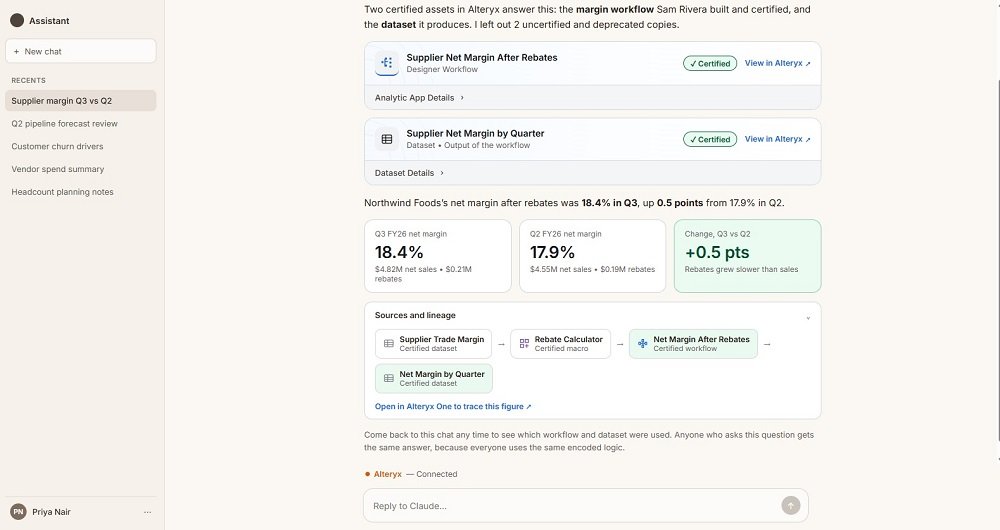
The architecture of the Vura Governance Experience is built upon a modular framework that integrates IT oversight directly into the business execution layer. At its core, the system acts as a centralized policy engine that enforces Software Development Lifecycle (SDLC) standards across the entire data ecosystem. Unlike legacy governance tools that operate in siloes, Vura synchronizes metadata across the Alteryx One platform, ensuring that data lineage is preserved from the initial ingestion point to the final output delivered via chat interfaces.
Key technical components include:
- Integrated SDLC Controls: IT administrators can define granular workflow requirements, including mandatory approval gates and peer-review protocols, which must be satisfied before a model is promoted to production.
- Real-Time Trust Signals: The system injects metadata directly into the user experience of major LLM interfaces, including OpenAI, Anthropic Claude, and Google Gemini. When an employee queries an AI agent, the Vura interface displays validation status, data freshness, and sensitivity labels in real-time.
- Automated Data Sensitivity Labeling: Utilizing Alteryx’s existing data cataloging capabilities, Vura automatically applies sensitivity tags to datasets. These tags dictate the permissible scope of AI interaction, preventing PII (Personally Identifiable Information) or proprietary financial data from being processed by unauthorized models.
- Version Control and Audit Trails: Every iteration of an AI-driven workflow is timestamped and logged. This provides a forensic trail that allows organizations to recreate past decisions, a critical requirement for sectors such as finance, healthcare, and manufacturing.
Industry Landscape and Competitive Comparison
The market for AI governance is currently fragmented, with vendors typically falling into two camps: broad data-management platforms and niche AI-security startups. Alteryx’s approach is distinct because it leverages its existing dominance in data preparation and analytics to provide a “governance-first” AI environment. While competitors often rely on post-hoc monitoring—inspecting AI outputs after they have been generated—the Vura Governance Experience shifts the focus to preventative control.
| Feature | Vura Governance Experience | Traditional Data Cataloging | Standalone AI Security Tools |
|---|---|---|---|
| Lifecycle Integration | Full (Design to Output) | Limited (Storage only) | Partial (Inference only) |
| Interface Compatibility | Native (OpenAI, Claude, Gemini) | None | API-based (Requires setup) |
| SDLC Enforcement | Automated Gates | Manual/Policy-based | Limited |
| Primary Focus | Process Transparency | Data Inventory | Threat Detection |
Practical Consumer & Enterprise Takeaways
For organizations considering the adoption of the Vura Governance Experience, the primary benefit is the reduction of “shadow AI” risks. By providing employees with a sanctioned, governed path to interact with LLMs, enterprises can discourage the use of unapproved tools that often leak sensitive corporate data. However, implementation is not a “set and forget” process. Organizations must invest time in defining their specific data sensitivity tiers and mapping their existing SDLC processes into the Alteryx framework.
From a cost-benefit perspective, the investment in Vura is an insurance policy against the hidden costs of AI errors. The expense of a single erroneous automated decision—ranging from regulatory fines to reputational damage—often dwarfs the overhead associated with implementing a robust governance framework. Enterprises with high regulatory burdens, such as those in the EU subject to the AI Act, will find the audit-ready nature of Vura to be a significant operational advantage.
Frequently Asked Questions
How does Vura handle data privacy when interacting with third-party LLMs like OpenAI or Claude?
Vura acts as an intermediary layer. Before data is transmitted to an external model, the governance engine checks the data sensitivity labels. If the data is classified as restricted or sensitive, the system automatically redacts or masks the information before it leaves the secure Alteryx environment, ensuring that external models process only the necessary, sanitized inputs.
Does the Vura Governance Experience require a full migration of existing workflows?
No. The system is designed to integrate with existing Alteryx One workflows. Organizations can implement Vura incrementally, starting with high-risk or high-visibility projects and expanding the governance framework across the enterprise as internal teams become accustomed to the new validation protocols.
Can developers override the governance gates in case of an emergency?
The platform supports “break-glass” protocols, but these are strictly logged and audited. Any override requires elevated administrative credentials and triggers an immediate compliance notification, ensuring that while business continuity is maintained, accountability remains intact.
The Bottom Line
The Vura Governance Experience represents a maturation of the enterprise AI sector. By moving away from the “move fast and break things” mentality of early generative AI experimentation, Alteryx is providing the necessary infrastructure to scale AI safely. While the platform requires a disciplined approach to configuration and policy setting, it provides a much-needed layer of accountability that the industry has lacked. For organizations seeking to balance the productivity gains of AI with the non-negotiable requirements of enterprise risk management, this platform offers a credible, technically sound pathway forward.