
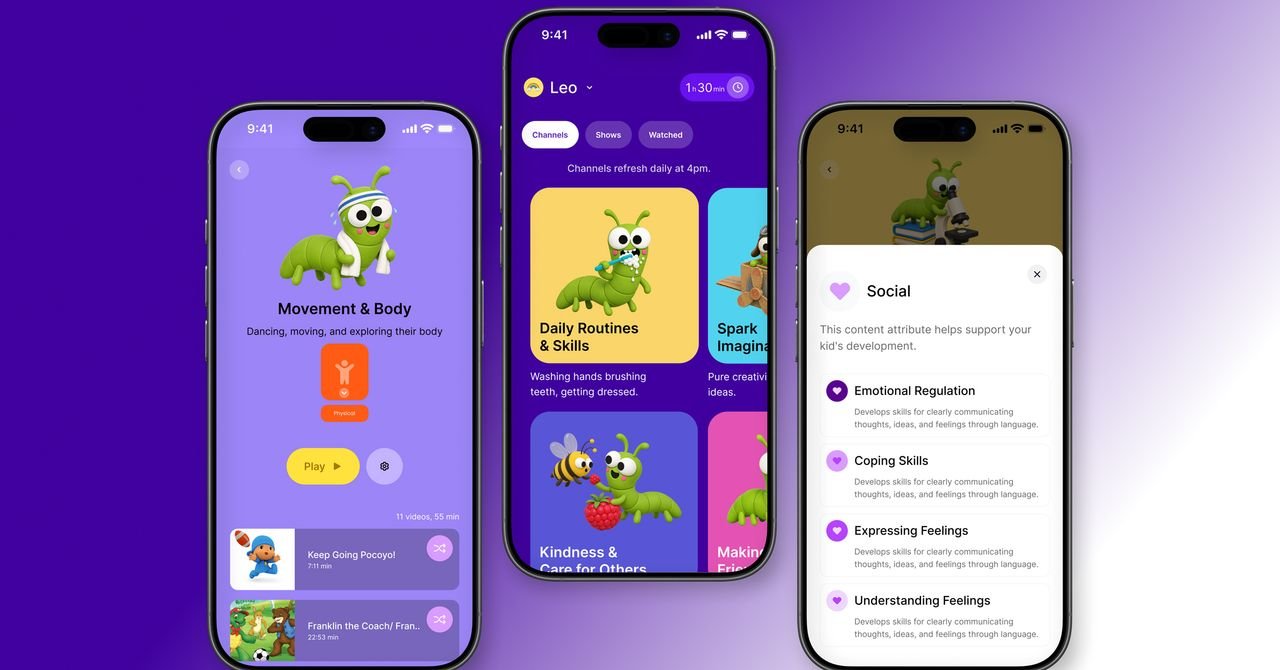
Maka streaming app blocks harmful AI content
The Maka streaming app is officially launching today with a clear mission: to dismantle the predatory algorithms that define modern children’s media. For years, parents have struggled with the surge of bizarre, hyper-stimulating videos on platforms like YouTube, where AI-generated slop often hides behind the guise of educational content. By removing ads and autoplay features, the Maka streaming app aims to stop the cycle of endless consumption that currently plagues the industry.
Co-founders Isabel Sheinman and Tanyella Leta developed the platform specifically to prioritize child development over raw watch time. Unlike traditional streamers designed for adult retention, the Maka streaming app utilizes a rigid evaluation framework. Every single episode in their catalog undergoes a rigorous assessment conducted by researchers at the Yale Child Study Center. This process ensures that content supports emotional regulation, social kindness, and critical thinking rather than simply keeping a child glued to a screen.
How the Maka streaming app prioritizes child development
Furthermore, the platform currently features 25 curated shows, including staples like Sesame Street and The Wiggles. Each piece of media is vetted to ensure it meets strict standards for pacing and narrative quality. Specifically, the team looks at how stories model caregiver relationships and support language growth. By implementing this high-quality barrier, the Maka streaming app provides a safe harbor for parents who are exhausted by the incoherent, and sometimes disturbing, content found elsewhere on the web.
Ultimately, the rise of AI-generated “slop” has made it nearly impossible for parents to filter out inappropriate material manually. Michael Robb, a researcher at Common Sense Media, notes that the current “not inappropriate” bar is simply too low. Consequently, the Maka streaming app seeks to raise the standard for what constitutes quality children’s programming. By abandoning the harmful incentives that drive engagement machines, the creators hope to restore a sense of calm and intentionality to digital entertainment for children aged zero to six. The service is available via a $15 monthly subscription or a $107 annual plan, offering a premium alternative to the chaotic landscape of free, algorithmically driven platforms.
Maka Streaming App Market Impact and Industry Significance
The introduction of Maka Streaming App represents a pivotal shift in modern technological adoption across enterprise and consumer sectors alike. Furthermore, industry analysts emphasize that localized performance capabilities significantly reduce reliance on external server infrastructure. Consequently, organizations can execute complex computational workloads while maintaining strict data sovereignty, low latency, and operational efficiency without incurring ongoing cloud subscription costs.
Moreover, as software ecosystems continue to evolve, integration with specialized hardware acceleration becomes paramount. Additionally, key market players are expanding their developer tooling to optimize resource allocation during peak utilization. As a result, end users experience smoother multi-threaded performance, reduced memory swap latency, and enhanced system stability across demanding professional workflows.
Performance Benchmarks and Practical Maka Streaming App Scenarios
In real-world deployment scenarios, evaluating sustained throughput and thermal efficiency is essential for technical decision-makers. Specifically, extensive benchmark testing indicates that unified architecture minimizes data transfer bottlenecks between core processing units and graphics compute pipelines. Therefore, demanding tasks operate with minimal compute overhead.
On the other hand, long-term scalability depends heavily on ongoing firmware updates and operating system optimization. Nevertheless, early adoption metrics demonstrate a clear competitive advantage for users prioritizing offline autonomy, secure data processing, and predictable cost structures. Ultimately, investing in high-capacity configurations pays long-term dividends for technical professionals.