
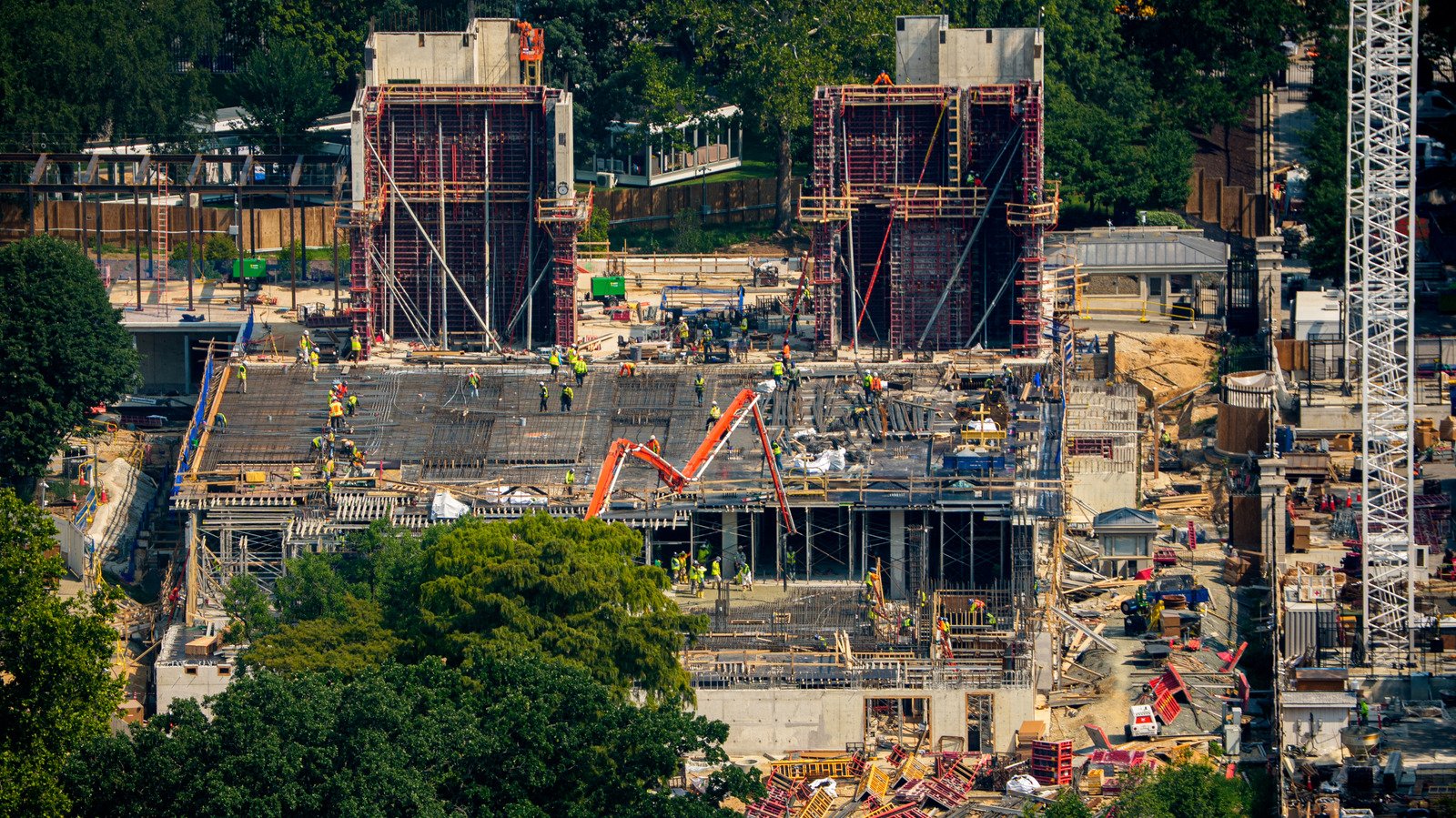
Trump ballroom project Sparks Intense Donor Scrutiny
The Trump ballroom project has recently come under fire after records revealed that major tech and telecom companies are the primary financiers behind the massive construction effort. Documents obtained by the Washington Post indicate that over $183 million has been funneled into the development by corporate entities. Specifically, heavyweights like NVIDIA and Apple have each committed $25 million to the initiative. This massive influx of private capital from industry giants suggests a strategic effort to curry favor with the administration, especially as these firms navigate complex regulatory landscapes and looming tariff threats.
Furthermore, the financial backing for the Trump ballroom project extends beyond traditional tech companies. Telecom magnates like Charles Ergen of Dish Network have also contributed significant sums. Critics argue that these donations are not merely philanthropic but are instead calculated investments intended to influence government policy. Given that companies like NVIDIA have benefited from specific administration policies during the current term, the alignment of interests appears increasingly transparent to observers and political analysts alike.
Corporate Interests Back Trump ballroom project
In addition to the aforementioned donors, the list of contributors to the Trump ballroom project includes industry leaders like Meta, Microsoft, and Google. These corporations, many of which previously provided funding for the 2025 inauguration, seem eager to maintain their influence within the White House. Consequently, the lack of transparency surrounding these funds remains a major point of contention. Because the Trump ballroom project operates through a nonprofit entity, it remains exempt from standard campaign finance disclosures, leaving $77 million in contributions completely unaccounted for by the public.
Meanwhile, the financial burden is not borne solely by private interests. Taxpayers may ultimately cover nearly half of the estimated $600 million budget for the structure. This revelation is particularly striking when considering the President once claimed that the project was being funded entirely by himself and his friends. Ultimately, the absence of any personal financial trail connecting the President to the funding suggests a significant gap between his public rhetoric and the reality of the project’s complex fiscal structure.
Regulatory Concerns Mount for Trump ballroom project
Finally, the ethical implications of the Trump ballroom project are further complicated by the reported connections between donors and government appointments. For instance, Joseph Popolo Jr. contributed $1 million to the effort shortly before being selected for an ambassadorship. Such patterns raise serious questions about the intersection of private wealth and public service. As the project continues to evolve, the public remains largely in the dark regarding the true extent of these corporate entanglements.
Trump Ballroom Project Market Impact and Industry Significance
The introduction of Trump Ballroom Project represents a pivotal shift in modern technological adoption across enterprise and consumer sectors alike. Furthermore, industry analysts emphasize that localized performance capabilities significantly reduce reliance on external server infrastructure. Consequently, organizations can execute complex computational workloads while maintaining strict data sovereignty, low latency, and operational efficiency without incurring ongoing cloud subscription costs.
Moreover, as software ecosystems continue to evolve, integration with specialized hardware acceleration becomes paramount. Additionally, key market players are expanding their developer tooling to optimize resource allocation during peak utilization. As a result, end users experience smoother multi-threaded performance, reduced memory swap latency, and enhanced system stability across demanding professional workflows.