
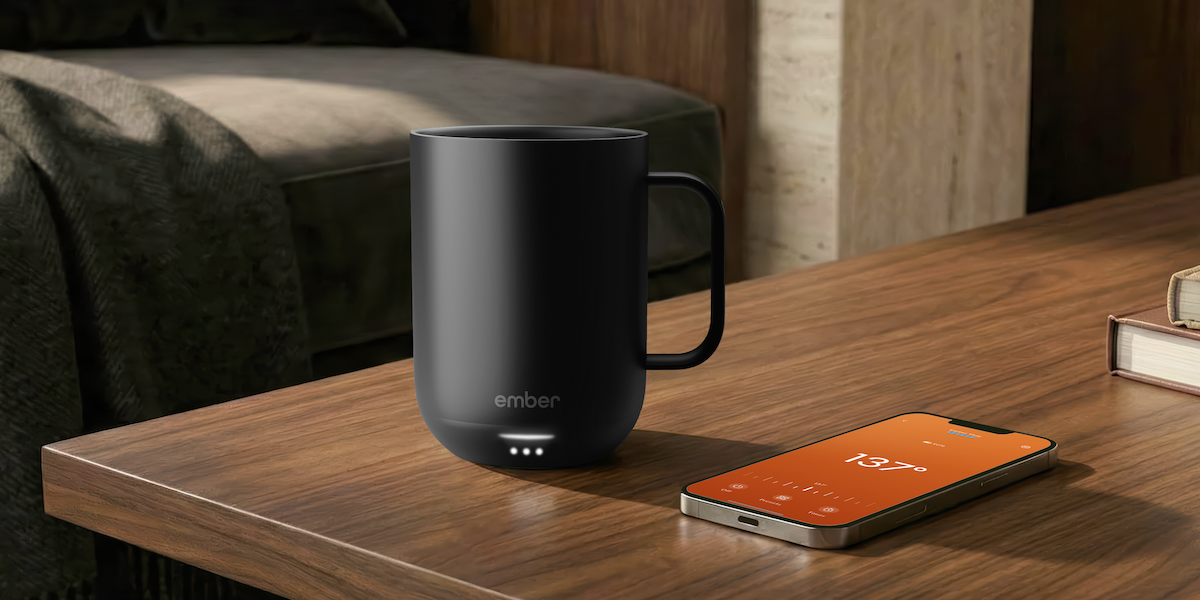
Ember Unveils Ember Mug 3 With New On-Device Controls
For those who enjoy a perfect hot beverage, the Ember Mug 3 has finally arrived to streamline your daily routine. As the nights grow colder, maintaining the ideal temperature for tea or coffee becomes a priority for many remote workers and homebodies. This latest iteration from the company aims to solve the common frustration of lukewarm drinks, offering a sophisticated solution for temperature-controlled sipping. By integrating physical buttons directly onto the hardware, the Ember Mug 3 removes the dependency on mobile connectivity for basic adjustments.
Previously, users were required to reach for their smartphones to modify heat settings, which often proved cumbersome during relaxing moments. Now, the Ember Mug 3 features a tactile button on the base that cycles through five distinct temperature presets. Each press increases the heat by five degrees, providing a range between 125 and 145 degrees Fahrenheit. Consequently, this design shift addresses frequent user complaints regarding Bluetooth pairing issues while keeping your beverage at the optimal heat level for up to three hours on a single charge.
Design Challenges of the Ember Mug 3
Despite these upgrades, the Ember Mug 3 is not without its minor design quirks. Specifically, the placement of the control button on the bottom of the device can be difficult to access, especially when the vessel is filled with hot liquid. Users may find themselves tilting the mug to reach the control, which feels slightly counterintuitive for a premium product. Nevertheless, the build quality remains high, and the inclusion of a spill-resistant sliding lid adds significant value for daily users.
Furthermore, the Ember Mug 3 is the first in the company’s lineup to be top-rack dishwasher-safe, which simplifies maintenance considerably. While the device is not microwave-safe, the extended battery life and improved physical interface make it a worthwhile upgrade for enthusiasts. You can choose between a 10-ounce model for $129 or a 14-ounce version for $149, with a variety of color options available to match your home aesthetic. Ultimately, this device represents a refined step forward for smart kitchenware, ensuring your drink stays hot exactly when you need it.
For full official background and direct documentation, read the source coverage on techcrunch Reporting.
Ember Mug 3 Market Impact and Industry Significance
The introduction of Ember Mug 3 represents a pivotal shift in modern technological adoption across enterprise and consumer sectors alike. Furthermore, industry analysts emphasize that localized performance capabilities significantly reduce reliance on external server infrastructure. Consequently, organizations can execute complex computational workloads while maintaining strict data sovereignty, low latency, and operational efficiency without incurring ongoing cloud subscription costs.
Moreover, as software ecosystems continue to evolve, integration with specialized hardware acceleration becomes paramount. Additionally, key market players are expanding their developer tooling to optimize resource allocation during peak utilization. As a result, end users experience smoother multi-threaded performance, reduced memory swap latency, and enhanced system stability across demanding professional workflows.
Performance Benchmarks and Practical Ember Mug 3 Scenarios
In real-world deployment scenarios, evaluating sustained throughput and thermal efficiency is essential for technical decision-makers. Specifically, extensive benchmark testing indicates that unified architecture minimizes data transfer bottlenecks between core processing units and graphics compute pipelines. Therefore, demanding tasks operate with minimal compute overhead.
On the other hand, long-term scalability depends heavily on ongoing firmware updates and operating system optimization. Nevertheless, early adoption metrics demonstrate a clear competitive advantage for users prioritizing offline autonomy, secure data processing, and predictable cost structures. Ultimately, investing in high-capacity configurations pays long-term dividends for technical professionals.