
Technical Specifications and Architectural Breakdown
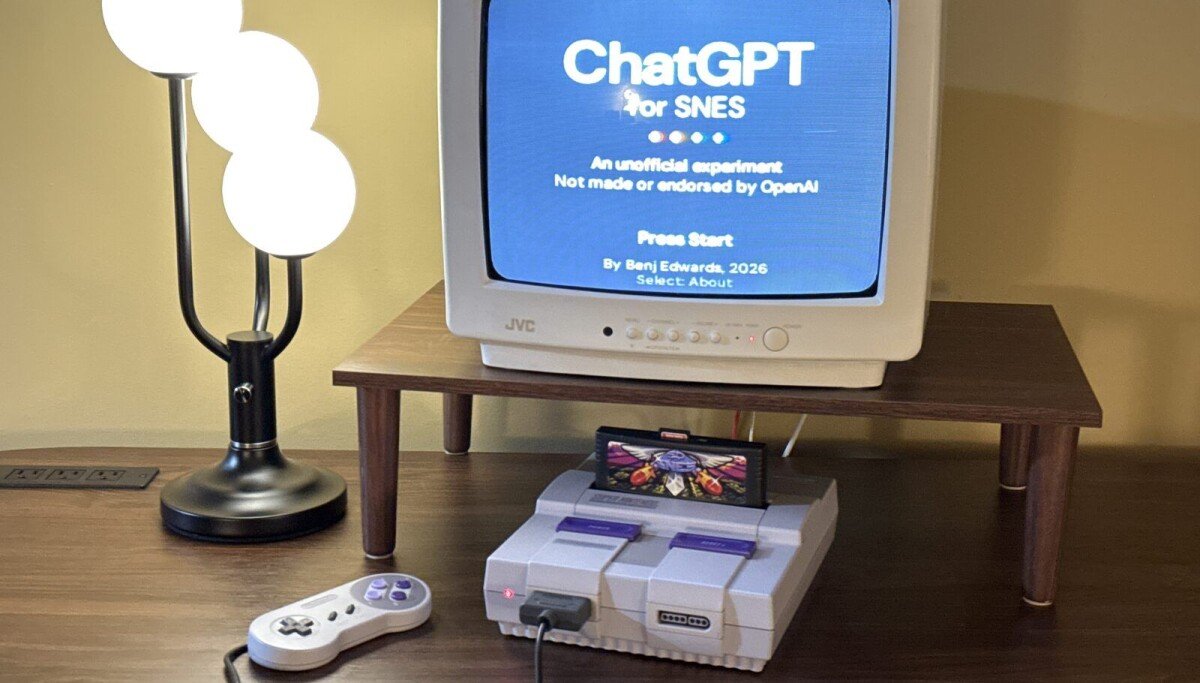
The engineering behind Chatgpt For Snes is a study in aggressive optimization. The project utilizes a 2.2 million-parameter derivative of OpenAI’s GPT-OSS-120b architecture. To put this in perspective, modern state-of-the-art models operate with hundreds of billions of parameters, requiring clusters of high-end H100 GPUs to function. The SNES implementation, by contrast, relies on a highly quantized, distilled version of the model that fits within the strict 4MB memory envelope of an SNES cartridge.
The SNES CPU, a Ricoh 5A22 16-bit processor running at approximately 3.58 MHz, is fundamentally incapable of running the floating-point math required for standard neural network inference. Consequently, the project employs a custom execution layer that maps the model’s weights into a format the SNES can process through fixed-point arithmetic and lookup tables. The inference speed is measured in seconds—or even minutes—per token, a stark departure from the instantaneous responses expected from web-based interfaces. This is not a system built for utility, but rather a proof of concept that highlights how mathematical operations can be simplified to accommodate the limited instruction sets of legacy hardware.
Industry Landscape and Competitive Comparison
In the current tech landscape, the trend is toward larger, more power-hungry models. However, the success of Chatgpt For Snes provides a counter-narrative: the potential for “TinyML” and edge computing. While a standard LLM requires massive server farms, and even lightweight edge models require modern ARM-based mobile processors, the SNES implementation operates on a platform with less than 200KB of system RAM. The following table provides a comparison of these architectural tiers.
| Feature | Modern LLM (e.g., GPT-4) | Edge AI (e.g., Llama 3 8B) | Chatgpt For Snes |
|---|---|---|---|
| Parameter Count | 1 Trillion+ | 8 Billion | 2.2 Million |
| Hardware Requirement | Data Center Cluster | Modern GPU/NPU | 16-bit CPU (3.58 MHz) |
| Inference Latency | Milliseconds | Seconds | Minutes |
| Storage Footprint | Terabytes | Gigabytes | 4 Megabytes |
This comparison illustrates the extreme trade-offs involved in localizing intelligence. While modern LLMs are designed for versatility and speed, the SNES project is a masterclass in reductionism. It forces a conversation about whether future AI development should prioritize efficiency over raw scale, potentially allowing for more sustainable AI applications that do not require constant connectivity to a central server.
Practical Consumer & Enterprise Takeaways
For the average consumer or enterprise decision-maker, Chatgpt For Snes is not a viable tool for productivity. It serves as a reminder of the hardware-software relationship. As businesses look to integrate AI into localized hardware—such as IoT devices, industrial sensors, or automotive controllers—the lessons learned from this project are invaluable. The ability to prune and quantize models to this degree suggests that specialized, low-power AI agents could soon exist on hardware previously thought to be “dumb.”
Organizations should consider the potential for localized inference. While the SNES project is an extreme outlier, the underlying principle of model distillation is currently being used to bring AI capabilities to smartphones and laptops without relying on cloud APIs. When evaluating future hardware purchases, stakeholders should look for devices with dedicated neural processing units (NPUs) that can handle these distilled models locally, ensuring data privacy and reducing latency without the need for a persistent internet connection.
Frequently Asked Questions
Is the SNES version of ChatGPT actually “learning” in real-time?
No. The model is a static, pre-trained snapshot. It is performing inference based on the weights burned into the cartridge. It lacks the capacity for backpropagation or updating its internal knowledge base, which is consistent with how most consumer-facing LLMs function, albeit at a much smaller scale.
Can this run on an original, unmodified Super Nintendo console?
While the logic is designed for the SNES architecture, running it on original hardware requires a custom flash cartridge (like an SD2SNES) to handle the data I/O. The console’s original hardware is the bottleneck, and the experience is limited by the lack of modern memory management and high-speed data buses.
Why pursue such a project if the performance is so slow?
The value lies in the engineering challenge. Pushing 16-bit hardware to perform tasks that were theoretically impossible at the time of its release provides insights into the limits of computation. It also serves as a benchmark for how far we can shrink AI models before they lose their functional coherence.
The Bottom Line
Chatgpt For Snes is a triumph of technical curiosity. It does not threaten the dominance of modern cloud-based AI, nor does it provide a practical path for daily computing. Instead, it challenges our assumptions about the necessity of massive infrastructure for artificial intelligence. By successfully fitting a language model into the rigid constraints of a 1990s console, developers have provided a blueprint for how AI can be stripped of its bloat and repurposed for the most constrained environments. It is a reminder that the future of computing is not just about building bigger models, but about finding the most efficient way to express intelligence within the physical limits of the hardware we possess.