
Figma AI Agents Get Specs Markdown Editor
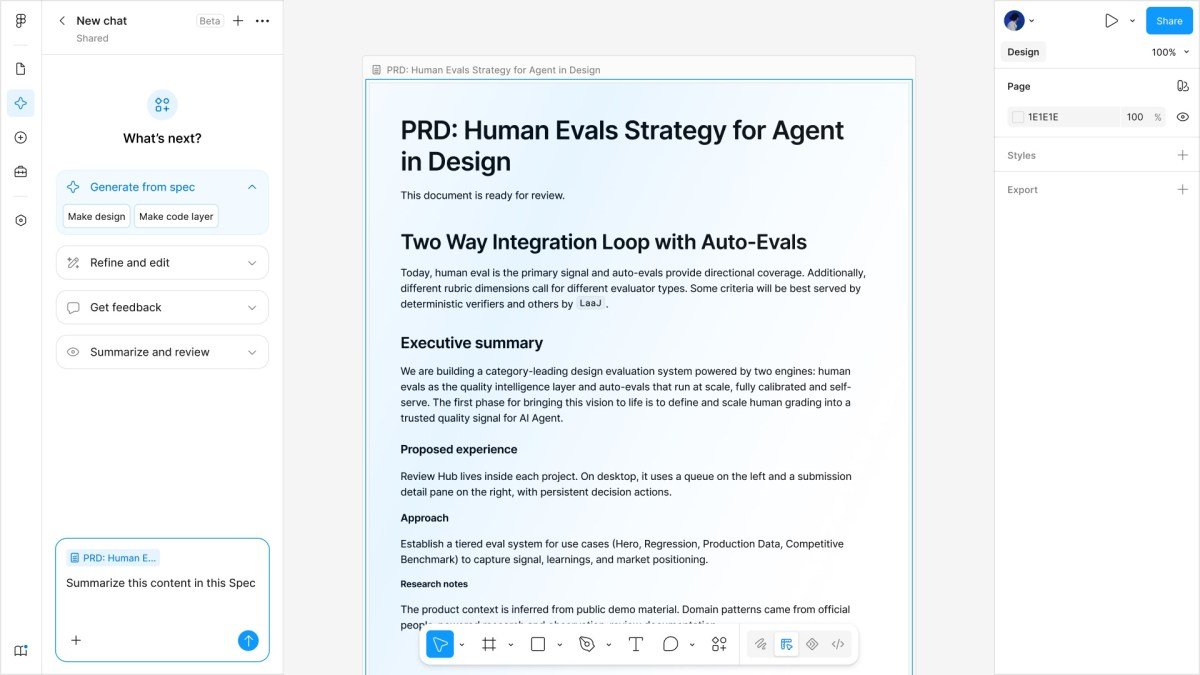
Figma AI agents now operate with clearer guardrails thanks to a new Markdown-based editor unveiled at the company’s first Config event in India. The feature, called Figma Specs, lets teams define design language in a simple format that both humans and automated systems can reference. Furthermore, these documents can exist as standalone files or live directly on the canvas alongside designs. Consequently, product teams gain a single source of truth that reduces ambiguity during handoff.
Users can embed FigJam diagrams, code layers, and canvas elements inside Specs documents. Additionally, the editor supports references to design libraries and code libraries, creating a centralized context hub. Meanwhile, Loredana Crisan, Figma’s chief design officer, told TechCrunch that software teams increasingly use code to explore ideas rather than ship final products. She noted that 17 times more lines of code are produced today versus the past, yet only 1.3 times more releases occur.
Code Layers Enter Public Beta for Prototypes
Figma AI agents can now generate and modify code directly on the canvas through the code layers feature. Previously available in private beta since June, this capability moves to public beta this week. Moreover, designers can ask the agent to transform a design into functional code or adjust specific code sections to iterate prototypes. This shift blurs the line between design and development, enabling faster validation of concepts.
The non-deterministic nature of AI remains a challenge, however. Figma addresses this by providing steering tools that guide agents toward predictable outcomes. For instance, Specs documents act as rulebooks that agents must follow. Nevertheless, the company acknowledges that human oversight remains essential for production-ready work.
Payload CMS Integration Powers Dynamic Sites
Last year’s acquisition of open-source headless CMS Payload now bears fruit through Figma Make integration. Teams can generate dynamic websites and manage content directly within the platform. Additionally, Payload’s downloads have surged sixfold over the past 12 months, signaling strong developer adoption. This integration positions Figma as a more complete solution for shipping web experiences.
India represents Figma’s largest market outside the United States, prompting the company to open its first office there late last year. The new facility houses sales, partnerships, go-to-market, and product support functions. Ultimately, this geographic focus reflects the platform’s growing influence in the region’s design community.
MCP Support Expands to 20 New Tools
Figma AI agents now connect with over 20 additional tools via the Model Context Protocol, including Open Code, Dia, Grok Bot, and Indian AI startup Sarvam. This expansion lets agents pull context from diverse sources while maintaining design system compliance. In addition, the protocol standardizes how external tools interact with Figma’s canvas, reducing integration friction for developers.
Overall, these announcements signal Figma’s ambition to become the central workspace where software teams decide what to build and ship. By combining design specifications, code generation, content management, and agent orchestration, the platform addresses the full product development lifecycle. For teams experimenting with AI-assisted workflows, the new toolkit offers structure without sacrificing flexibility.
For official technical specifications and hardware documentation, visit AMD Official Specifications or MSI Technical Specs.
Figma AI Agents Market Impact and Industry Significance
The introduction of Figma AI Agents represents a pivotal shift in modern technological adoption across enterprise and consumer sectors alike. Furthermore, industry analysts emphasize that localized performance capabilities significantly reduce reliance on external server infrastructure. Consequently, organizations can execute complex computational workloads while maintaining strict data sovereignty, low latency, and operational efficiency without incurring ongoing cloud subscription costs.
Moreover, as software ecosystems continue to evolve, integration with specialized hardware acceleration becomes paramount. Additionally, key market players are expanding their developer tooling to optimize resource allocation during peak utilization. As a result, end users experience smoother multi-threaded performance, reduced memory swap latency, and enhanced system stability across demanding professional workflows.
Performance Benchmarks and Practical Figma AI Agents Scenarios
In real-world deployment scenarios, evaluating sustained throughput and thermal efficiency is essential for technical decision-makers. Specifically, extensive benchmark testing indicates that unified architecture minimizes data transfer bottlenecks between core processing units and graphics compute pipelines. Therefore, demanding tasks operate with minimal compute overhead.
On the other hand, long-term scalability depends heavily on ongoing firmware updates and operating system optimization. Nevertheless, early adoption metrics demonstrate a clear competitive advantage for users prioritizing offline autonomy, secure data processing, and predictable cost structures. Ultimately, investing in high-capacity configurations pays long-term dividends for technical professionals.