
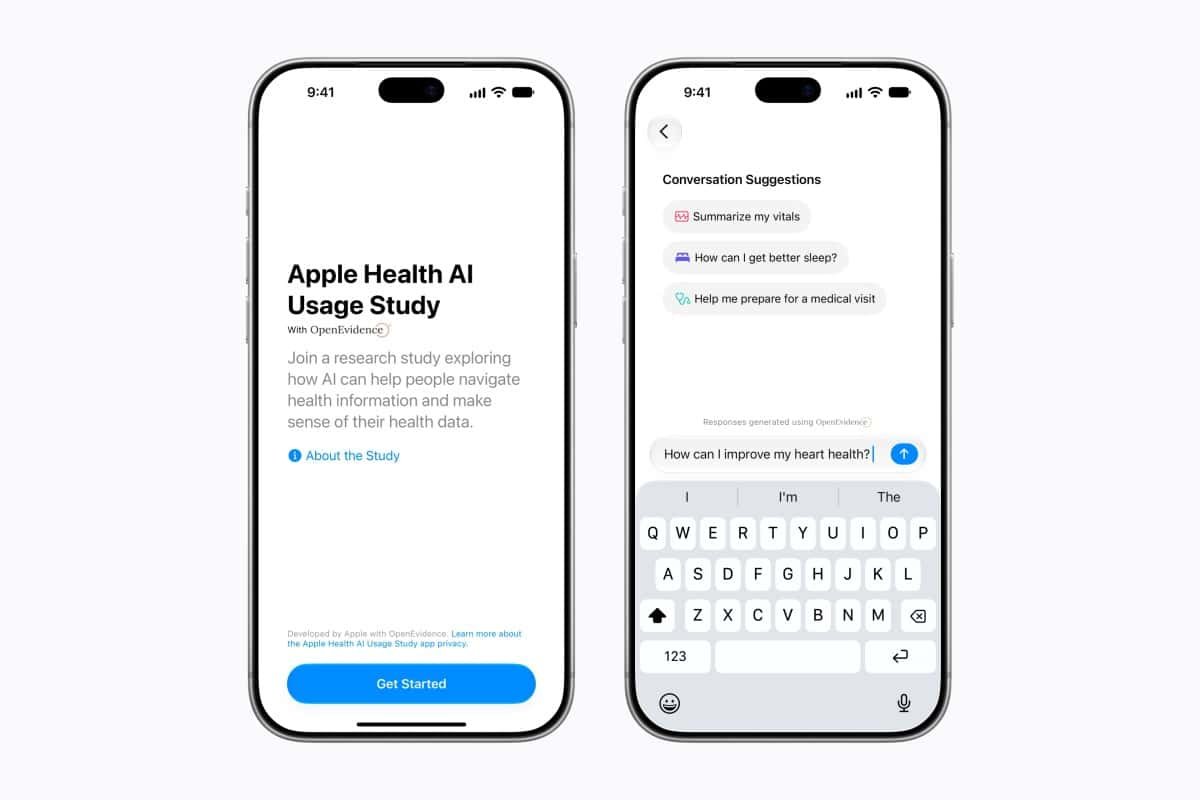
Technical Specifications and Architectural Breakdown
The architecture underpinning the Health AI Study represents a departure from standard generative AI training protocols. While many consumer-facing models rely on massive, uncurated datasets scraped from the open web, Apple’s research-focused implementation utilizes a Retrieval-Augmented Generation (RAG) approach. This system restricts the model’s knowledge base to a library of high-impact, peer-reviewed journals, including The New England Journal of Medicine and Nature.
To participate, U.S. residents aged 21 and older must utilize an iPhone 15 or later, running the latest iteration of iOS 26, with Apple Intelligence features fully enabled. The study, which spans a 12-month duration, captures granular user feedback loops. When a participant poses a health-related query, the system retrieves relevant excerpts from the approved clinical index, summarizes them, and presents them in simplified language. Participants are then prompted to evaluate the utility, clarity, and perceived accuracy of the output. This human-in-the-loop validation is critical; it allows Apple’s researchers to measure the “grounding” of the model—a metric representing how closely the AI’s output adheres to the source material without drifting into speculative or anecdotal territory.
From an engineering perspective, the system operates within a privacy-first sandbox. Unlike general-purpose models that often use user interactions to further train their underlying weights, this study employs anonymized data protocols. The model is not learning from the user’s personal health history in a way that creates a persistent, identifiable medical profile; rather, it is testing the model’s ability to interpret complex clinical data for a lay audience under controlled, research-grade conditions.
Industry Landscape and Competitive Comparison
The current landscape of medical AI is dominated by general-purpose models like OpenAI’s GPT-4 and Anthropic’s Claude. While these tools demonstrate impressive linguistic capabilities, they are inherently prone to the “black box” problem, where the reasoning path from input to output is opaque and potentially influenced by non-clinical training data. Apple’s entry into this space is not an attempt to build a better chatbot, but rather to build a more reliable information retrieval system.
| Feature | General AI Chatbots | Apple Health AI Study |
|---|---|---|
| Primary Data Source | Broad Internet Crawl | Peer-Reviewed Clinical Journals |
| Privacy/Training | Variable/Active Model Training | Anonymized/No Model Training |
| Primary Goal | Conversational Versatility | Evidence-Based Accuracy |
| Error Mitigation | Probabilistic Filtering | Source-Anchored Grounding |
The competitive advantage here is not in the size of the model, but in the restriction of the input. By limiting the model to a “walled garden” of medical knowledge, Apple is effectively reducing the surface area for errors. This stands in stark contrast to competitors that prioritize broad knowledge, often at the expense of domain-specific rigor.
Practical Consumer & Enterprise Takeaways
For the average user, this study serves as a litmus test for the future of personal health management. If the current study proves successful, it is likely that these capabilities will eventually be integrated into the broader Apple Health ecosystem, potentially transforming the iPhone into a primary interface for medical information. However, users should maintain a clear distinction between “information” and “diagnosis.” Even with perfect grounding, an AI model is not a substitute for a licensed healthcare professional.
For enterprise stakeholders and healthcare providers, the implications are significant. If Apple succeeds in creating a reliable, grounded interface, it could set a new industry benchmark for clinical information retrieval. Organizations should monitor these developments closely, as they indicate a move toward standardized, auditable AI outputs. The cost-benefit trade-off for the consumer is currently weighted toward participation—users contribute to a longitudinal research effort in exchange for early access to a sophisticated, source-verified information tool. Those considering participation should ensure they are comfortable with the data-sharing agreements required by the study’s institutional review board.
Frequently Asked Questions
Is the information provided by the AI considered a medical diagnosis?
No. The AI is designed to provide information synthesized from clinical literature to assist with research and understanding. It is explicitly not a diagnostic tool and does not replace the judgment, testing, or clinical expertise of a doctor.
How does this study differ from using a standard search engine for health queries?
Standard search engines return a list of links, requiring the user to manually verify the credibility of the sources. The Health AI Study performs the retrieval, synthesis, and summarization, providing a single, grounded response that is directly linked to reputable clinical journals.
Will my health data be used to train future AI models?
Apple has stated that the data collected during this study is anonymized and is not used to train the model in the traditional sense of persistent weight adjustment. The focus is on evaluating the accuracy of the existing model’s responses during the study period.
The Bottom Line
Apple’s Health AI Study is a calculated, cautious, and technically sound approach to a high-stakes problem. By prioritizing the provenance of data over the breadth of training, the company is attempting to define the parameters of responsible AI in medicine. While it remains to be seen whether such a model can achieve the level of nuance required for complex clinical scenarios, the methodology—anchored in peer-reviewed literature and conducted through rigorous research protocols—is a necessary step forward. For now, the project represents a promising shift toward accountability in an industry that has historically favored speed over precision.