
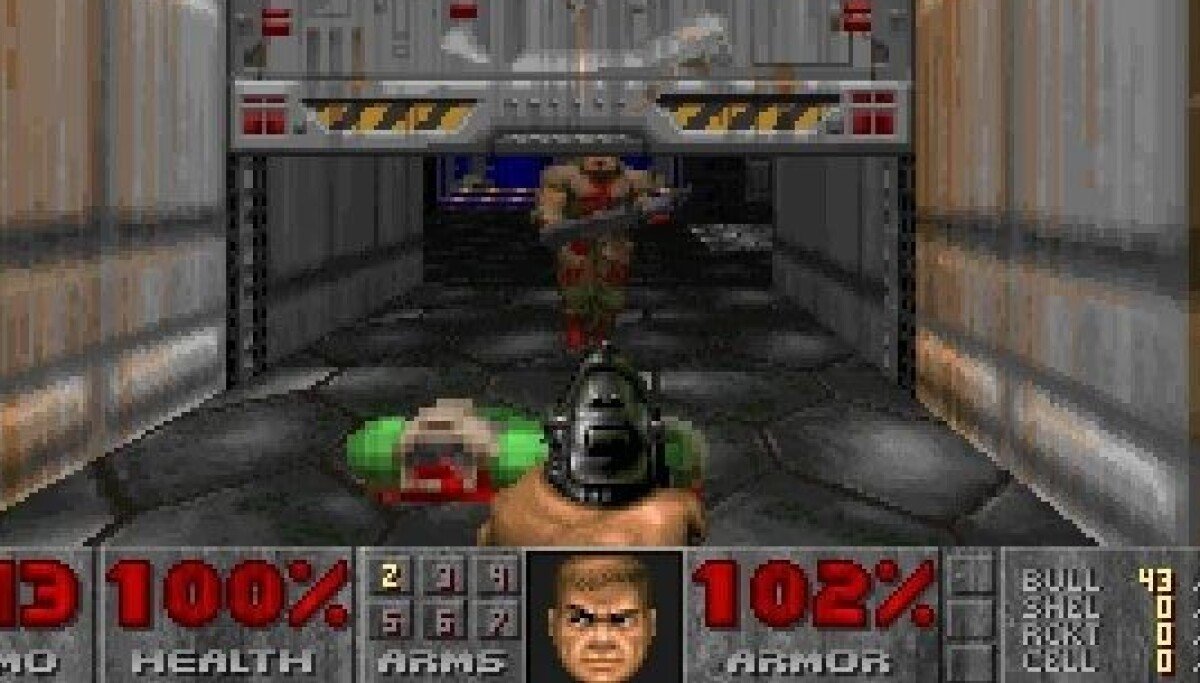
Doom on DNS Experiment Pushes Domain System Limits
A developer has successfully implemented Doom on DNS by treating the domain name system as a programmable database, though performance remains severely constrained. The project demonstrates that DNS records can store arithmetic operations and conditional logic, effectively transforming name resolution into a general-purpose computing platform. Each 32-bit addition requires four separate DNS queries, while branching instructions demand five lookups, making real-time gameplay impossible.
Furthermore, the experiment reveals fundamental architectural gaps in DNS design. The system lacks native clock signals and instruction sequencing, requiring external wiring to function as a computer. BIND responds to queries in approximately 7 microseconds over TCP and 4 microseconds via UDP, yet a single frame demands 6.6 million lookups. Consequently, even optimized implementations achieve only one frame every 146 seconds, rendering the experience turn-based at best.
Paul Vixie Recognizes Creative RFC 2136 Usage
Notably, the developer shared results with Paul Vixie, co-author of RFC 2136 and architect of BIND 8. Vixie reportedly described the project as “the best use of RFC 2136 DNS UPDATE” he had encountered, though the compliment offered no practical performance improvements. The RFC enables dynamic DNS updates, which the implementation exploits for memory storage and state management during program execution.
Additionally, the researcher explored lookahead optimizations to reduce latency. By prefetching instruction blocks and packing registers densely, the initial 577-second frame time dropped significantly. However, BIND’s inherent query processing overhead creates a hard ceiling that software optimization alone cannot overcome. The experiment highlights how DNS was never designed for computational workloads, despite its database-like characteristics.
Database Theory Meets Gaming History
Modern databases support exotic data types including geometric shapes, MAC addresses, and full-text search vectors. PostgreSQL handles circles and polygons, while Oracle stores ROWID references. The Doom on DNS project essentially replicates this concept using TXT records and UPDATE operations as primitive memory cells. Each DNS response becomes an instruction result, chained together to simulate a von Neumann architecture.
Meanwhile, the choice of Doom as the target program follows a longstanding tradition. The 1993 shooter has been ported to pregnancy tests, ATMs, and smart lightbulbs. Running it on DNS infrastructure adds another entry to this catalog, though with uniquely theoretical implications. The project proves that any system capable of storing and retrieving structured data can theoretically execute arbitrary code, regardless of original design intent.
For those interested in the technical details, the RFC 2136 specification defines the dynamic update mechanism exploited here. Similarly, BIND documentation explains the name server architecture that powers this unconventional computer. Ultimately, the experiment serves as both a curiosity and a reminder that computational universality emerges in unexpected places.
Doom On Dns Market Impact and Industry Significance
The introduction of Doom On Dns represents a pivotal shift in modern technological adoption across enterprise and consumer sectors alike. Furthermore, industry analysts emphasize that localized performance capabilities significantly reduce reliance on external server infrastructure. Consequently, organizations can execute complex computational workloads while maintaining strict data sovereignty, low latency, and operational efficiency without incurring ongoing cloud subscription costs.
Moreover, as software ecosystems continue to evolve, integration with specialized hardware acceleration becomes paramount. Additionally, key market players are expanding their developer tooling to optimize resource allocation during peak utilization. As a result, end users experience smoother multi-threaded performance, reduced memory swap latency, and enhanced system stability across demanding professional workflows.
Performance Benchmarks and Practical Doom On Dns Scenarios
In real-world deployment scenarios, evaluating sustained throughput and thermal efficiency is essential for technical decision-makers. Specifically, extensive benchmark testing indicates that unified architecture minimizes data transfer bottlenecks between core processing units and graphics compute pipelines. Therefore, demanding tasks operate with minimal compute overhead.
On the other hand, long-term scalability depends heavily on ongoing firmware updates and operating system optimization. Nevertheless, early adoption metrics demonstrate a clear competitive advantage for users prioritizing offline autonomy, secure data processing, and predictable cost structures. Ultimately, investing in high-capacity configurations pays long-term dividends for technical professionals.
Ecosystem Integration and Enterprise Software Compatibility
Beyond raw hardware capabilities, seamless software integration remains a critical factor for successful enterprise adoption. Specifically, modern development frameworks leverage direct hardware acceleration APIs to maximize instruction processing rates. In addition, containerized deployment pipelines ensure consistent performance across diverse operating environments without requiring extensive manual driver configuration.
Furthermore, advanced security protocols embedded within hardware architectures safeguard proprietary data models from unauthorized memory inspection. Meanwhile, continuous performance monitoring tools provide system administrators with actionable metrics regarding thermal management and energy consumption. Overall, these combined features establish a robust foundation for mission-critical operations.