
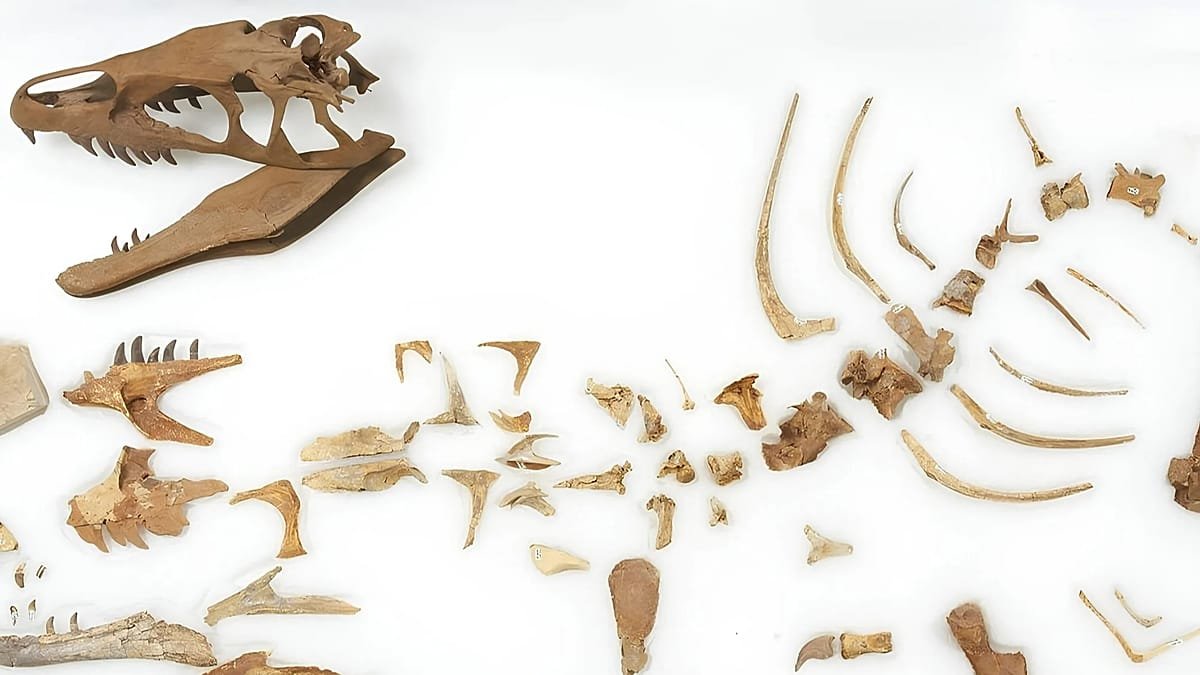
France Halts Auction of Rare Dubreuillosaurus valesdunensis
In a significant move to preserve scientific heritage, the French state has successfully intervened to acquire the Dubreuillosaurus valesdunensis, a 167-million-year-old carnivorous dinosaur skeleton. The specimen, which was slated for a public auction at the Hôtel Drouot in Paris, was withdrawn following a mutual agreement between the state and the heirs of the original owner. This rare Dubreuillosaurus valesdunensis specimen represents the only known example of its kind, making its preservation a top priority for the global paleontological community.
Dubreuillosaurus Valesdunensis: Scientific Value and Historical Context
Discovered in 1994 by André Dubreuil in Normandy, the Dubreuillosaurus valesdunensis was unearthed during excavation campaigns led by the Centre for Research in Palaeontology. Unlike many other fossils found in the region, which were sadly destroyed during the 1944 bombing raids, this skeleton remains remarkably intact. Its skull is considered one of the most complete and well-preserved examples of a theropod dinosaur in Europe. This discovery has provided researchers with unprecedented insight into the anatomy of megalosaurs, a group that was previously poorly understood in the fossil record.
Preservation for Future Research
The decision to halt the auction comes after intense pressure from scientists who feared the loss of such a vital specimen to private hands. By securing the Dubreuillosaurus valesdunensis for the National Museum of Natural History in Paris, the state ensures that the fossil remains accessible to researchers and the public alike. The skeleton is currently slated to be housed in the Gallery of Palaeontology and Comparative Anatomy at the Jardin des Plantes, which is expected to reopen in 2027.
Key Facts About the Fossil
- Species: Dubreuillosaurus valesdunensis, a theropod related to megalosaurs.
- Age: Approximately 167 million years old.
- Discovery Site: Conteville, Eure, Normandy.
- Status: The only known representative of its species globally.
What This Means Going Forward
The acquisition of the Dubreuillosaurus valesdunensis is more than just a win for museum curation; it is a victory for open science. Moving forward, the specimen will undergo advanced digital analysis, including new scanner-based biomechanical reconstructions, to further unlock the mysteries of its life cycle. By keeping the Dubreuillosaurus valesdunensis within the public domain, France has set a benchmark for the protection of rare paleontological assets against the volatility of the private auction market. This ensures that the legacy of André Dubreuil’s find will continue to inform our understanding of prehistoric life for generations to come.
For full official background and direct documentation, read the source coverage on Euronews.com Reporting.