
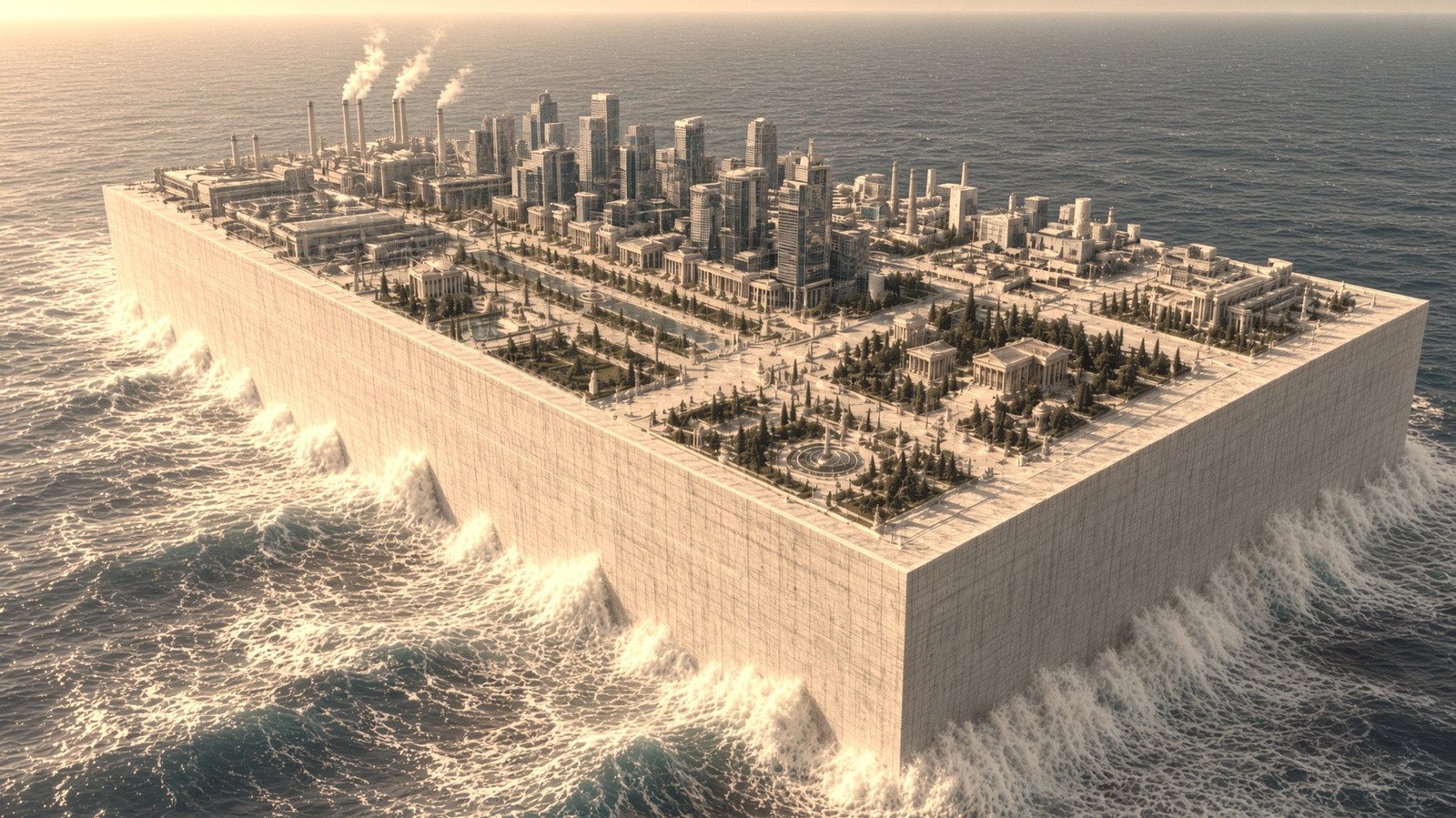
Technical Specifications and Architectural Breakdown
The Slab Seastead is engineered for extreme longevity, with a design life targeting 1,000 years. Unlike traditional offshore oil rigs or temporary research platforms, which rely on periodic maintenance and eventual decommissioning, the Slab is designed as a permanent, modular urban environment. The structural integrity of the platform is predicated on high-density concrete composites and reinforced steel alloys capable of withstanding the corrosive environment of the mid-ocean for centuries.
Architecturally, the platform is divided into three functional strata. The foundation layer houses the power generation and desalination infrastructure, utilizing modular nuclear reactors—likely based on small modular reactor (SMR) technology—to ensure total energy independence. The mid-section serves as the industrial core, featuring automated refineries and chemical processing plants designed with tight-loop recycling systems to minimize environmental impact while maximizing throughput. The upper strata consist of high-density residential and commercial zones, featuring office spaces and living quarters designed to attract the high-skilled labor force required to operate such a facility. The entire structure is modular, allowing for the addition of peripheral platforms as the population and industrial capacity of the seastead scale.
Industry Landscape and Competitive Comparison
To understand the significance of the Slab Seastead, one must distinguish it from existing offshore infrastructure. While the tech industry has previously experimented with floating data centers—primarily for the purpose of passive cooling and proximity to subsea fiber-optic cables—those projects were never intended to function as sovereign entities. They remain tethered to the legal jurisdictions of the nations whose waters they occupy. The Slab, conversely, is intended to exist in a jurisdictional vacuum, governed by its own internal protocols rather than the Environmental Protection Agency or the Occupational Safety and Health Administration.
| Feature | Traditional Floating Data Center | Offshore Oil Rig | Slab Seastead |
|---|---|---|---|
| Primary Objective | Server Cooling | Resource Extraction | Sovereign Industrial Growth |
| Jurisdictional Status | Subject to Flag Laws | Subject to Flag Laws | Independent City-State |
| Design Life | 10–20 Years | 25–40 Years | 1,000 Years |
| Operational Focus | Bandwidth/Latency | Extraction Efficiency | Regulatory Autonomy |
Practical Consumer & Enterprise Takeaways
For enterprise stakeholders, the Slab Seastead presents a complex cost-benefit analysis. The primary advantage is the elimination of regulatory friction. Companies burdened by the high cost of compliance in industries like advanced manufacturing or specialized chemical synthesis may find the prospect of an offshore facility compelling. By moving operations to international waters, firms can theoretically accelerate research and development cycles that would take years to navigate through domestic permitting processes.
However, the trade-offs are significant. The logistical costs of operating in the middle of the ocean are substantial. Supply chain reliability, the transportation of raw materials, and the export of finished goods to global markets will require a sophisticated, high-cost maritime logistics network. Furthermore, the legal status of a sovereign seastead remains untested. International maritime law is designed to manage transit and resource extraction, not the establishment of autonomous industrial cities. Enterprises considering a move to a platform like the Slab must account for the risk of diplomatic intervention or the potential for future international treaties to impose new regulations on such entities.
Frequently Asked Questions
What is the legal status of the Slab Seastead in international waters?
While the project aims for sovereignty, international law regarding artificial islands is complex. Under the United Nations Convention on the Law of the Sea (UNCLOS), artificial islands do not possess the status of islands and do not have a territorial sea of their own. Their legal status remains a matter of ongoing debate, and they would likely remain subject to the jurisdiction of the state that registered the platform.
How does the Slab handle waste management and environmental impact?
The platform is designed to operate as a closed-loop system. Because the facility is intended to be a long-term, self-sustaining environment, it utilizes advanced filtration and recycling technologies to prevent the discharge of pollutants into the surrounding ocean. The goal is to maintain a zero-footprint operation to avoid triggering international environmental sanctions.
Is the Slab Seastead a viable option for small-scale startups?
Currently, the infrastructure costs associated with the Slab are prohibitive for most startups. The platform is designed for large-scale industrial operations and established corporations with the capital to sustain long-term maritime logistics. It is not a co-working space; it is a specialized industrial zone requiring significant upfront investment.
The Bottom Line
The Slab Seastead is an ambitious engineering project that highlights a growing frustration among technologists with the pace of modern regulatory frameworks. By attempting to decouple industrial production from national borders, Luckey is pushing the boundaries of what is technically and legally possible. While the engineering vision is impressive, the project faces immense hurdles, from the harsh realities of oceanic logistics to the unresolved questions of international law. Whether the Slab becomes a viable model for the future of industry or remains a high-concept experiment will depend on its ability to navigate the very real-world pressures it seeks to escape.