
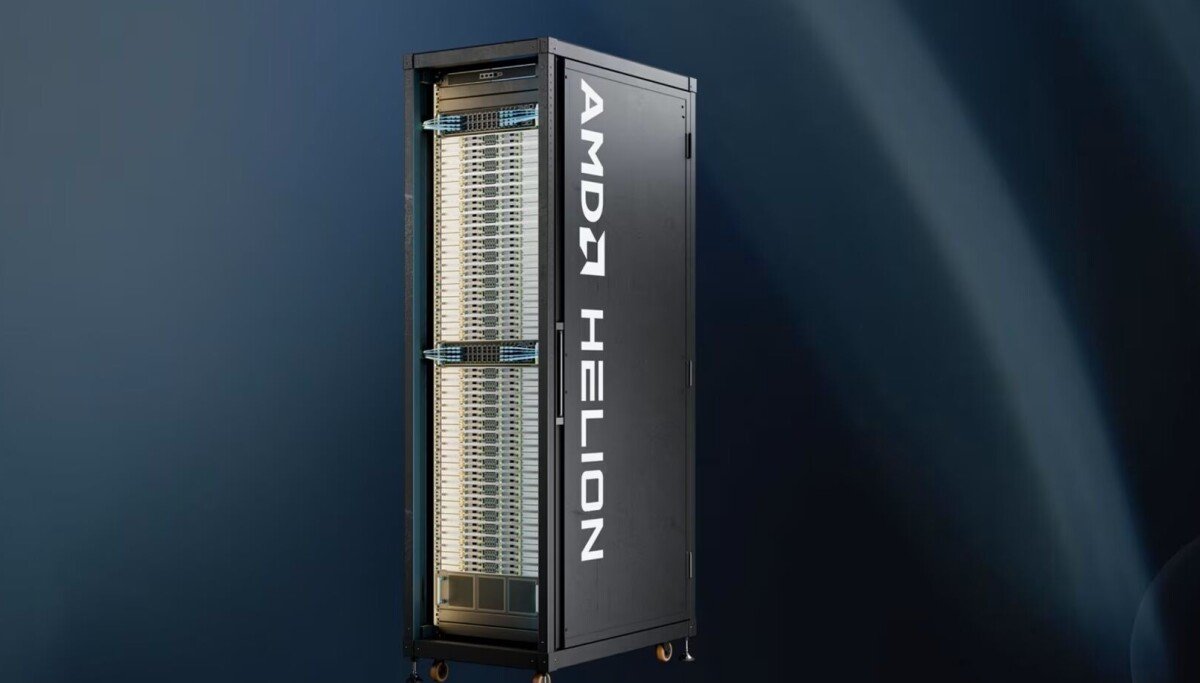
AMD Helion Debuts at OCP Summit 2026
AMD Helion takes center stage at the Open Compute Project Summit in San Jose as the chipmaker expands its rack-scale portfolio for agentic AI workloads. The new reference design arrives months after the Helios launch, though the similar naming convention risks confusion among enterprise buyers. This latest blueprint focuses squarely on AI agent execution and inference within a single OCP-compliant rack, offering organizations a choice between CPU-only hyperscale configurations and mixed CPU-GPU enterprise deployments.
Dan McNamara, AMD’s senior vice president for Compute and Enterprise AI, emphasized that agentic AI spans diverse enterprise applications and complex workflows. Each workload demands different compute characteristics, and the Helion architecture addresses this variability through modular blade options. Partners including Cisco, Dell, HPE, Foxconn, Lenovo, and Supermicro have already signed on to build systems based on these specifications.
AMD Helion Configuration Options Detailed
The hyperscale variant delivers dedicated capacity for agent execution while connecting to separate model inference infrastructure. Meanwhile, the enterprise configuration consolidates agent execution, GPU inference, and supporting workloads into one rack. Both approaches support dense, balanced, and high-performance CPU blade tiers. Dense blades employ 256-core EPYC 9006 processors rated at 400 watts, while performance blades feature 96-core variants clocked at 5 GHz. Balanced blades utilize 256-core chips at 600 watts for throughput-oriented tasks.
GPU inference blades pack eight Instinct MI350P accelerators into a 5U form factor. General-purpose blades handle database, storage, and technical computing workloads. Maximum configurations reach 32,768 Zen 6 CPU cores alongside 16 MI350P GPUs with 102 Tbps of networking bandwidth. These specifications will be contributed to the OCP community for further development, with partner systems expected in November 2026.
Industry Impact and Availability Timeline
Analysts note that AMD Helion represents a strategic push into the emerging agentic AI infrastructure segment. By offering both air-cooled and liquid-cooled variants, AMD addresses diverse datacenter constraints. The open specification approach could accelerate adoption across the partner ecosystem. For more details on OCP standards, visit the Open Compute Project website. Enterprise customers evaluating AI agent platforms should also review AMD’s server processor roadmap for complementary technology decisions.
Amd Helion Market Impact and Industry Significance
The introduction of Amd Helion represents a pivotal shift in modern technological adoption across enterprise and consumer sectors alike. Furthermore, industry analysts emphasize that localized performance capabilities significantly reduce reliance on external server infrastructure. Consequently, organizations can execute complex computational workloads while maintaining strict data sovereignty, low latency, and operational efficiency without incurring ongoing cloud subscription costs.
Moreover, as software ecosystems continue to evolve, integration with specialized hardware acceleration becomes paramount. Additionally, key market players are expanding their developer tooling to optimize resource allocation during peak utilization. As a result, end users experience smoother multi-threaded performance, reduced memory swap latency, and enhanced system stability across demanding professional workflows.
Performance Benchmarks and Practical Amd Helion Scenarios
In real-world deployment scenarios, evaluating sustained throughput and thermal efficiency is essential for technical decision-makers. Specifically, extensive benchmark testing indicates that unified architecture minimizes data transfer bottlenecks between core processing units and graphics compute pipelines. Therefore, demanding tasks operate with minimal compute overhead.
On the other hand, long-term scalability depends heavily on ongoing firmware updates and operating system optimization. Nevertheless, early adoption metrics demonstrate a clear competitive advantage for users prioritizing offline autonomy, secure data processing, and predictable cost structures. Ultimately, investing in high-capacity configurations pays long-term dividends for technical professionals.
Ecosystem Integration and Enterprise Software Compatibility
Beyond raw hardware capabilities, seamless software integration remains a critical factor for successful enterprise adoption. Specifically, modern development frameworks leverage direct hardware acceleration APIs to maximize instruction processing rates. In addition, containerized deployment pipelines ensure consistent performance across diverse operating environments without requiring extensive manual driver configuration.
Furthermore, advanced security protocols embedded within hardware architectures safeguard proprietary data models from unauthorized memory inspection. Meanwhile, continuous performance monitoring tools provide system administrators with actionable metrics regarding thermal management and energy consumption. Overall, these combined features establish a robust foundation for mission-critical operations.
3 thoughts on “AMD Helion Rack Design Targets Agentic AI Workloads”