
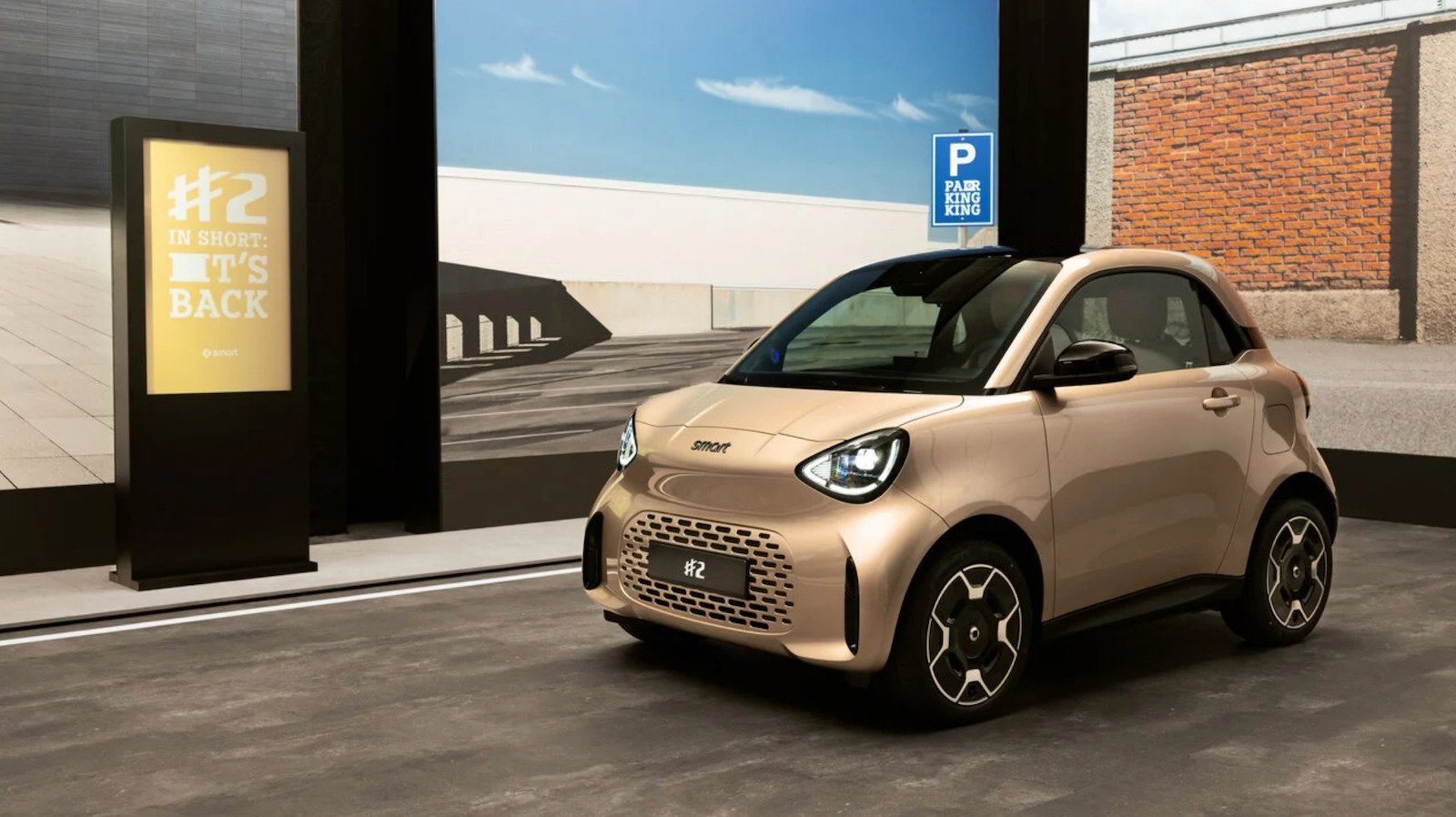
Smart #2 EV Returns to Ultra-Compact Roots
The Smart #2 EV marks a dramatic return to form for the Mercedes-Geely joint venture, four years after the #1 crossover debuted. Unveiled at the Paris Motor Show, this two-seater measures just 2.7 meters long, making navigation through congested European city centers effortless. Furthermore, its rear-mounted 60kW motor delivers 130Nm of torque directly to wider rear tires, a configuration that enhances stability during tight cornering. Consequently, the vehicle reclaims the maneuverability that defined the original Fortwo while integrating modern EV architecture.
Design cues deliberately echo the iconic Fortwo, including two-tone color schemes and a truncated rear overhang. However, the interior tells a different story. A 10.1-inch central touchscreen pairs with an 8.8-inch driver display, both running Smart’s latest interface with wireless 4G, Wi-Fi, and Bluetooth connectivity. Additionally, driver assistance systems come standard across all trims, a notable inclusion for a vehicle targeting the budget segment.
Smart #2 EV: Powertrain and Charging Specifications
The floor-mounted battery pack provides up to 180 miles (290 km) per charge under WLTP testing, a respectable figure for urban duty cycles. Moreover, DC fast charging capability allows a 10-to-80 percent replenishment in roughly 20 minutes at compatible stations. Meanwhile, the five-link rear suspension promises improved ride quality over the Fortwo’s torsion beam setup, addressing a longstanding criticism of the previous generation. For comparison, the EV Database lists average city EV ranges near 150 miles, positioning the Smart #2 EV competitively.
Trim Levels and Premium Features
Four distinct trims structure the lineup. The entry Pure model includes the core feature set, while Pure+ adds 11kW AC charging and a heated driver seat. Furthermore, the Premium tier introduces a panoramic glass roof, heated leather upholstery, and a seven-speaker Sennheiser audio system. At the apex, the Couture Edition limits production to 999 units globally, distinguished by a white exterior, gold-painted roof, and gold-accented wheel detailing. Notably, each trim retains the same powertrain, ensuring consistent performance regardless of equipment level.
Market Availability and Pricing Outlook
Smart confirms a starting price below $26,500 (£20,000), undercutting most rivals in the segment. Preorders open this spring with summer deliveries planned for European markets. Nevertheless, the automaker has not sold vehicles in the United States since 2019, and current regulatory preferences for larger SUVs make a North American launch unlikely. Overall, the Smart #2 EV represents a focused execution of urban mobility principles, though its regional exclusivity limits global impact.
Smart #2 EV Market Impact and Industry Significance
The introduction of Smart #2 EV represents a pivotal shift in modern technological adoption across enterprise and consumer sectors alike. Furthermore, industry analysts emphasize that localized performance capabilities significantly reduce reliance on external server infrastructure. Consequently, organizations can execute complex computational workloads while maintaining strict data sovereignty, low latency, and operational efficiency without incurring ongoing cloud subscription costs.
Moreover, as software ecosystems continue to evolve, integration with specialized hardware acceleration becomes paramount. Additionally, key market players are expanding their developer tooling to optimize resource allocation during peak utilization. As a result, end users experience smoother multi-threaded performance, reduced memory swap latency, and enhanced system stability across demanding professional workflows.
Performance Benchmarks and Practical Smart #2 EV Scenarios
In real-world deployment scenarios, evaluating sustained throughput and thermal efficiency is essential for technical decision-makers. Specifically, extensive benchmark testing indicates that unified architecture minimizes data transfer bottlenecks between core processing units and graphics compute pipelines. Therefore, demanding tasks operate with minimal compute overhead.
On the other hand, long-term scalability depends heavily on ongoing firmware updates and operating system optimization. Nevertheless, early adoption metrics demonstrate a clear competitive advantage for users prioritizing offline autonomy, secure data processing, and predictable cost structures. Ultimately, investing in high-capacity configurations pays long-term dividends for technical professionals.
Ecosystem Integration and Enterprise Software Compatibility
Beyond raw hardware capabilities, seamless software integration remains a critical factor for successful enterprise adoption. Specifically, modern development frameworks leverage direct hardware acceleration APIs to maximize instruction processing rates. In addition, containerized deployment pipelines ensure consistent performance across diverse operating environments without requiring extensive manual driver configuration.
Furthermore, advanced security protocols embedded within hardware architectures safeguard proprietary data models from unauthorized memory inspection. Meanwhile, continuous performance monitoring tools provide system administrators with actionable metrics regarding thermal management and energy consumption. Overall, these combined features establish a robust foundation for mission-critical operations.