
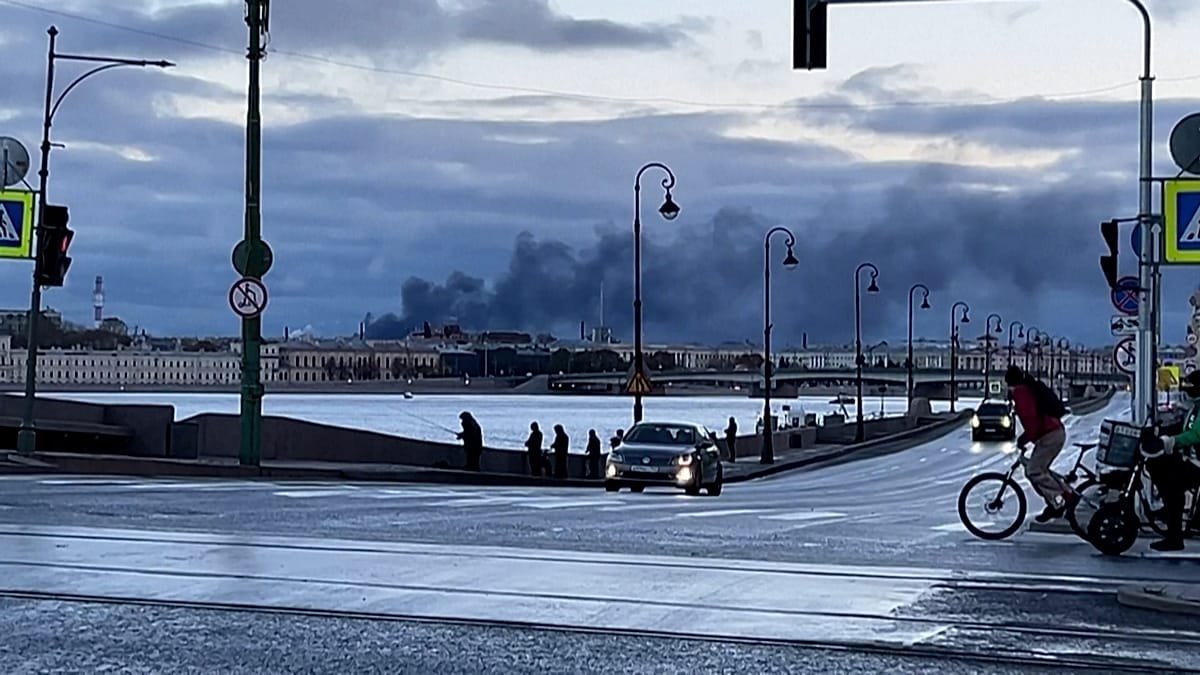
St Petersburg Drone Attacks Spark Massive Industrial Fires
Massive drone attacks struck St Petersburg and the surrounding Leningrad region early Sunday, sending towering plumes of thick black smoke billowing over Russia’s second-largest city. Regional officials reported that air-defense systems intercepted numerous inbound aerial threats, but falling debris and direct impacts still triggered fierce blazes across vital industrial sites and logistics hubs.
Meanwhile, footage circulating across social media platforms captured a devastating fire raging at a major warehouse operated by Ozon, the country’s second-largest online retailer. Additional imagery highlighted heavy smoke pouring from the St Petersburg Oil Terminal, alongside unconfirmed reports of secondary blasts near nearby fuel depots and regional oil refineries.
Infrastructure Targets and Casualties in the Region
Alexander Beglov, the governor of St Petersburg, formally confirmed that emergency defense grids were forced to activate during the overnight assault. Although defense operators claimed to have neutralized dozens of airborne threats, the sheer scale of the coordinated operation led to severe infrastructure damage across multiple municipal districts.
- At least 126 to 144 incoming units were intercepted by regional air defenses.
- A primary Ozon logistics center suffered catastrophic structural damage from fire.
- Operations at Pulkovo Airport faced temporary safety restrictions.
- One fatality and five injuries were officially confirmed by local emergency services.
Because of the escalating volatility, local authorities scrambled emergency crews to contain the roaring industrial flames. Meanwhile, civilian air traffic experienced sudden operational restrictions as aviation officials prioritized safety around the airspace of the stricken metropolis.
The Broader Clash Over Regional Energy Grids
This dramatic escalation coincides with renewed announcements regarding strikes on domestic fuel infrastructure. Observers note that both sides continue to treat energy grids, refineries, and storage depots as high-priority targets in a conflict that shows no signs of slowing down.
Ultimately, these ongoing clashes highlight the extreme vulnerability of urban industrial hubs to modern remote aerial tactics. As regional authorities assess the physical and economic wreckage, the long-term stability of local energy supply chains remains under severe threat.
For full official background and direct documentation, read the source coverage on Euronews.com Reporting.