
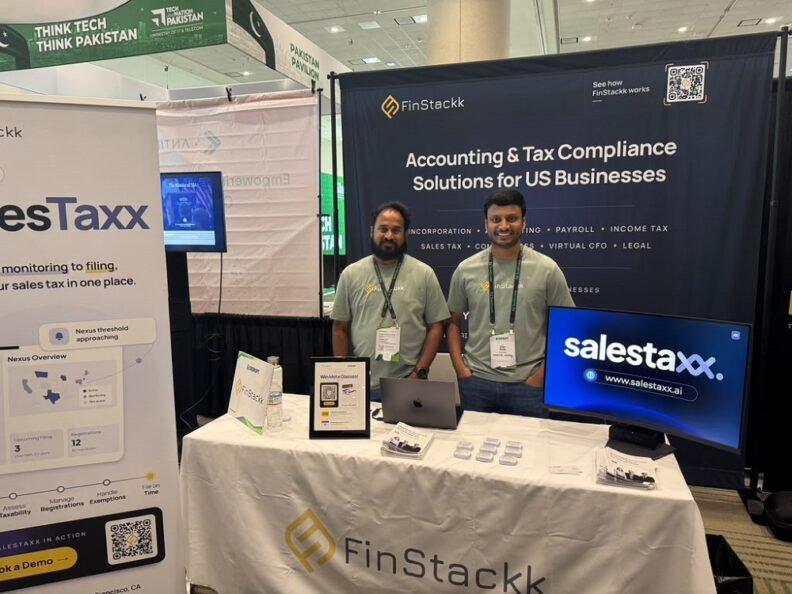
FinStackk Unveils SalesTaxx Compliance Platform
FinStackk has officially launched its SalesTaxx compliance platform, a sophisticated tool designed to simplify the intricate world of US sales tax obligations. Announced at TechCrunch Disrupt 2026, this technology provides growing enterprises and accounting firms with a reliable way to monitor their tax liabilities across all states. Managing these requirements manually often leads to errors, but this new solution automates the process to ensure businesses remain fully compliant without needing to hire dedicated tax specialists.
Since the landmark 2018 Wayfair ruling, the landscape for remote sellers has changed drastically. Companies can now face significant tax burdens in states where they lack a physical presence. Consequently, missing a registration deadline can force businesses to absorb tax costs directly from their profit margins. The SalesTaxx compliance platform mitigates these risks by tracking thresholds in real-time and alerting users to the exact date their collection obligations begin.
Automating Complex Tax Filings
Beyond simple monitoring, the system offers robust filing capabilities. It calculates tax rates across state, county, city, and district levels, ensuring high accuracy for every transaction. Furthermore, the SalesTaxx compliance platform prepares necessary returns and files them only after receiving explicit user approval. This workflow gives founders peace of mind while maintaining full control over their financial reporting duties.
Specifically, the platform integrates with major industry tools, including QuickBooks, Xero, Stripe, and Shopify. Such connectivity ensures that financial data flows seamlessly between systems, reducing the manual burden on accounting teams. As companies expand their reach, the tool adjusts to handle registration in new states or the closure of inactive accounts, providing a comprehensive lifecycle management service for tax compliance.
Empowering Accounting Professionals
Ultimately, the SalesTaxx compliance platform serves as a force multiplier for CPA firms. By providing a centralized dashboard, accounting professionals can manage multiple clients through a standardized process. This efficiency allows firms to offer tax compliance as a scalable, billable service without the need to expand their internal headcounts. Meanwhile, the platform provides direct access to human tax experts, ensuring that complex queries receive professional attention whenever necessary.
Satya Yeruva, CEO of FinStackk, emphasized that founders should focus on their core business rather than navigating obscure tax laws. By using the SalesTaxx compliance platform, businesses gain an early warning system that acts like an in-house expert. This strategic approach ensures that startups and established ecommerce brands can scale across the US market with total confidence and minimal regulatory friction.
Salestaxx Compliance Platform Market Impact and Industry Significance
The introduction of Salestaxx Compliance Platform represents a pivotal shift in modern technological adoption across enterprise and consumer sectors alike. Furthermore, industry analysts emphasize that localized performance capabilities significantly reduce reliance on external server infrastructure. Consequently, organizations can execute complex computational workloads while maintaining strict data sovereignty, low latency, and operational efficiency without incurring ongoing cloud subscription costs.
Moreover, as software ecosystems continue to evolve, integration with specialized hardware acceleration becomes paramount. Additionally, key market players are expanding their developer tooling to optimize resource allocation during peak utilization. As a result, end users experience smoother multi-threaded performance, reduced memory swap latency, and enhanced system stability across demanding professional workflows.
Performance Benchmarks and Practical Salestaxx Compliance Platform Scenarios
In real-world deployment scenarios, evaluating sustained throughput and thermal efficiency is essential for technical decision-makers. Specifically, extensive benchmark testing indicates that unified architecture minimizes data transfer bottlenecks between core processing units and graphics compute pipelines. Therefore, demanding tasks operate with minimal compute overhead.
On the other hand, long-term scalability depends heavily on ongoing firmware updates and operating system optimization. Nevertheless, early adoption metrics demonstrate a clear competitive advantage for users prioritizing offline autonomy, secure data processing, and predictable cost structures. Ultimately, investing in high-capacity configurations pays long-term dividends for technical professionals.