
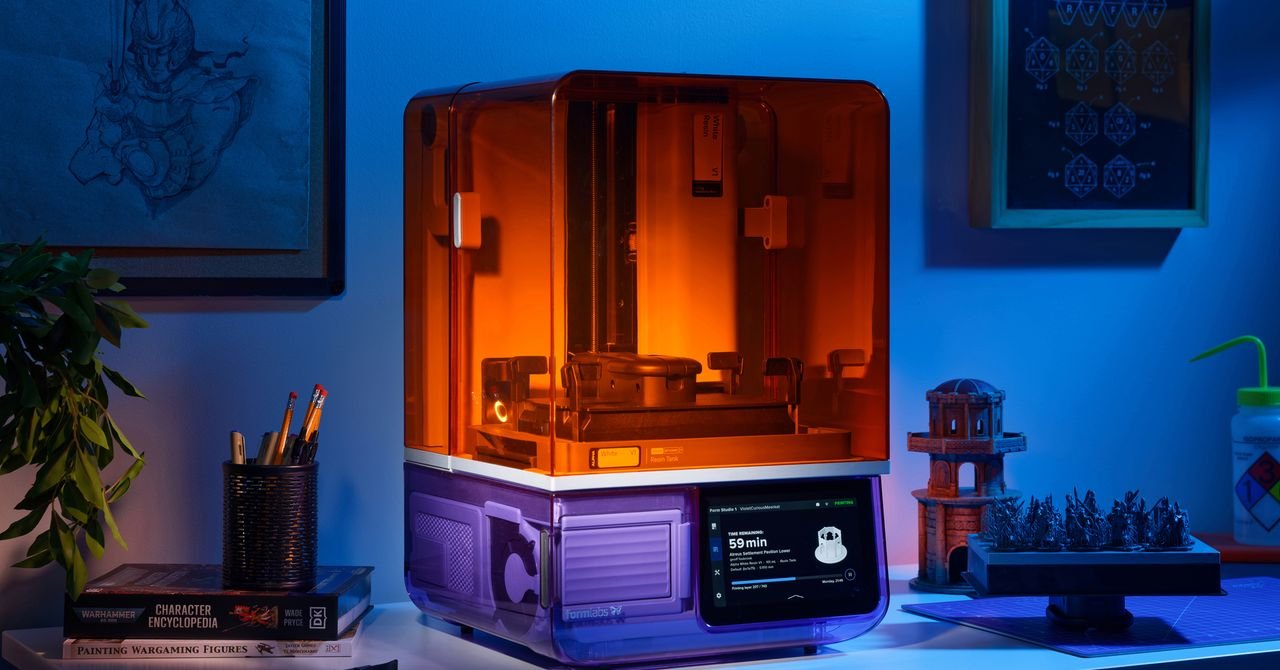
Form Studio 1 Marks Formlabs Entry Into Consumer Market
The Form Studio 1 arrives as Formlabs’ first genuine attempt to reach everyday makers rather than just professional shops. Fourteen cardboard boxes filled the WIRED testing area, each containing components for this new desktop machine. Chief product officer David Lakatos emphasized the compact footprint, claiming the unit fits comfortably on any standard desk. That claim holds up — the printer occupies roughly the same space as a minifridge, though the required wash and cure station adds another similarly sized box to the setup.
Formlabs has deployed nearly 200,000 units across industrial and medical settings since its founding. Their existing customer base consists primarily of dental labs, assembly houses, and engineering firms accustomed to spending $2,500 or more per machine. The previous entry-level option sat at $2,300, placing it well beyond hobbyist budgets. This new model slashes that barrier to $699, with individual resin cartridges starting at $29.
SLA Technology Delivers Detail Without the Stink
Stereolithography printing uses ultraviolet light to cure liquid resin into solid plastic layer by layer. The process typically produces strong odors, but Formlabs developed Alpha resins carrying UL GreenGuard certification — the same safety standard applied to baby products. When paired with the optional VOC extractor, the Form Studio 1 runs quietly and with minimal smell. Lakatos noted that some users might even operate the device in bedrooms, though he personally keeps his printers elsewhere.
The translucent orange chassis evokes the original iMac aesthetic, a deliberate design choice signaling consumer appeal. A front-mounted touchscreen handles print preparation and troubleshooting. Early tests produced a clear Raspberry Pi enclosure in roughly seventeen minutes, emerging clean and intact. The resin scent remained contained until the hood lifted post-print.
Third-Party Resin Support Expands Material Options
Unlike many locked-down consumer printers, the Form Studio 1 accepts third-party resins alongside Formlabs’ own formulations. This flexibility matters for experimenters who want specialized properties — flexible, tough, or high-temperature materials — without paying premium prices. The separate wash and cure unit, priced at $199, removes uncured resin from finished parts and finalizes the curing process. Both machines share similar dimensions, so prospective buyers should plan for double the desktop real estate.
Formlabs claims an eight-minute print time for a Raspberry Pi case, though real-world results vary with geometry and layer height. The review unit produced consistent results across multiple test prints. A full evaluation will explore long-term reliability, resin costs over time, and how the ecosystem compares to filament-based alternatives like Bambu Lab or Prusa offerings.
For makers who’ve watched professional SLA quality from the sidelines, this launch represents a genuine inflection point. The Form Studio 1 delivers industrial-grade resolution at a price that finally makes sense for home workshops. Formlabs now faces the challenge of supporting a vastly broader user base while maintaining the reliability that built their reputation.
Form Studio 1 Market Impact and Industry Significance
The introduction of Form Studio 1 represents a pivotal shift in modern technological adoption across enterprise and consumer sectors alike. Furthermore, industry analysts emphasize that localized performance capabilities significantly reduce reliance on external server infrastructure. Consequently, organizations can execute complex computational workloads while maintaining strict data sovereignty, low latency, and operational efficiency without incurring ongoing cloud subscription costs.
Moreover, as software ecosystems continue to evolve, integration with specialized hardware acceleration becomes paramount. Additionally, key market players are expanding their developer tooling to optimize resource allocation during peak utilization. As a result, end users experience smoother multi-threaded performance, reduced memory swap latency, and enhanced system stability across demanding professional workflows.
Performance Benchmarks and Practical Form Studio 1 Scenarios
In real-world deployment scenarios, evaluating sustained throughput and thermal efficiency is essential for technical decision-makers. Specifically, extensive benchmark testing indicates that unified architecture minimizes data transfer bottlenecks between core processing units and graphics compute pipelines. Therefore, demanding tasks operate with minimal compute overhead.
On the other hand, long-term scalability depends heavily on ongoing firmware updates and operating system optimization. Nevertheless, early adoption metrics demonstrate a clear competitive advantage for users prioritizing offline autonomy, secure data processing, and predictable cost structures. Ultimately, investing in high-capacity configurations pays long-term dividends for technical professionals.
Ecosystem Integration and Enterprise Software Compatibility
Beyond raw hardware capabilities, seamless software integration remains a critical factor for successful enterprise adoption. Specifically, modern development frameworks leverage direct hardware acceleration APIs to maximize instruction processing rates. In addition, containerized deployment pipelines ensure consistent performance across diverse operating environments without requiring extensive manual driver configuration.
Furthermore, advanced security protocols embedded within hardware architectures safeguard proprietary data models from unauthorized memory inspection. Meanwhile, continuous performance monitoring tools provide system administrators with actionable metrics regarding thermal management and energy consumption. Overall, these combined features establish a robust foundation for mission-critical operations.