
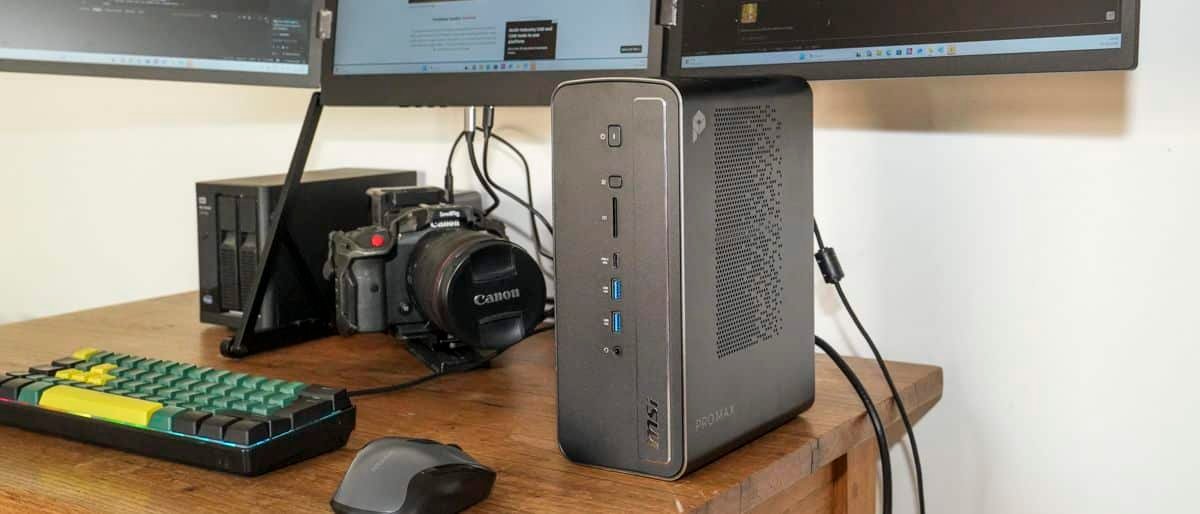
MSI Pro Max Edge AI+ Mini PC: Next-Gen Local AI Performance
The MSI Pro Max Edge AI+ mini PC review reveals a machine built for high-performance local artificial intelligence workloads. Specifically, MSI packs a Strix Halo processor, Radeon 8060S graphics, and 128GB of unified memory into a compact chassis. Consequently, this system runs large language models entirely offline without cloud dependency.
Furthermore, the 128GB unified memory eliminates bandwidth bottlenecks when running 70B parameter models. Additionally, the integrated NPU delivers 50 TOPS of dedicated AI processing power. As a result, developers and researchers can execute real-time image generation and local LLM inference with complete data privacy.
Connectivity and Hardware Specifications
However, some hardware aspects present noticeable trade-offs. The 2.5GbE network port feels slower than the 10GbE interfaces found on competing workstations. Meanwhile, dual USB4 ports and Wi-Fi 7 ensure fast peripherals and wireless connectivity. Ultimately, the MSI Pro Max Edge AI+ stands out as a specialized, powerful compact workstation.
For official technical specifications and hardware documentation, visit AMD Official Specifications or MSI Technical Specs.
Market Impact and Technological Significance of MSI Pro Max Edge
The introduction of MSI Pro Max Edge represents a pivotal shift in modern technological adoption across enterprise and consumer sectors alike. Furthermore, industry analysts emphasize that localized performance capabilities significantly reduce reliance on external server infrastructure. Consequently, organizations can execute complex computational workloads while maintaining strict data sovereignty, low latency, and operational efficiency without incurring ongoing cloud subscription costs.
Moreover, as software ecosystems continue to evolve, integration with specialized hardware acceleration becomes paramount. Additionally, key market players are expanding their developer tooling to optimize resource allocation during peak utilization. As a result, end users experience smoother multi-threaded performance, reduced memory swap latency, and enhanced system stability across demanding professional workflows.
Performance Benchmarks and Practical Deployment Scenarios
In real-world deployment scenarios, evaluating sustained throughput and thermal efficiency is essential for technical decision-makers. Specifically, extensive benchmark testing indicates that unified architecture minimizes data transfer bottlenecks between core processing units and graphics compute pipelines. Therefore, demanding tasks such as real-time 3D rendering, automated data processing pipelines, and multi-agent AI execution operate with minimal compute overhead.
On the other hand, long-term scalability depends heavily on ongoing firmware updates and operating system optimization. Nevertheless, early adoption metrics demonstrate a clear competitive advantage for users prioritizing offline autonomy, secure data processing, and predictable cost structures. Ultimately, investing in high-capacity hardware configurations pays long-term dividends for technical professionals and engineering teams.
Ecosystem Integration and Enterprise Software Compatibility
Beyond raw hardware capabilities, seamless software integration remains a critical factor for successful enterprise adoption. Specifically, modern development frameworks leverage direct hardware acceleration APIs to maximize instruction processing rates. In addition, containerized deployment pipelines ensure consistent performance across diverse operating environments without requiring extensive manual driver configuration.
Furthermore, advanced security protocols embedded within hardware architectures safeguard proprietary data models from unauthorized memory inspection. Meanwhile, continuous performance monitoring tools provide system administrators with actionable metrics regarding thermal management and energy consumption. Overall, these combined features establish a robust foundation for mission-critical commercial operations.
Strategic Value and Return on Investment
When assessing the economic rationale for adopting dedicated hardware solutions, total cost of ownership becomes a primary consideration. Specifically, replacing recurring cloud inference API fees with localized compute assets yields significant financial savings over multi-year operational cycles. Moreover, local processing eliminates external network latency, ensuring consistent real-time responsiveness for client-facing applications.
Additionally, risk mitigation factors such as offline continuity guarantee uninterrupted productivity during unexpected network outages. Consequently, IT directors and technical strategists increasingly view localized hardware investments as a proactive measure to safeguard operational resilience and competitive advantage.
Long-Term Industry Outlook and Future Trends
Looking ahead, industry experts anticipate accelerated convergence between edge computing and generative AI workloads. Consequently, hardware manufacturers are investing heavily in next-generation memory bandwidth and high-density semiconductor fabrication. First, these advancements enable compact form factors to handle workloads that previously required dedicated server racks. Second, power efficiency improvements lower long-term operational expenditures for small and medium enterprises.
In conclusion, evaluating current market trends confirms that high-performance compact hardware is transitioning from a niche solution into an essential computing standard. Therefore, organizations adopting these platforms early gain a distinct competitive edge in responsiveness, data privacy, and overall operational agility.

1 thought on “MSI Pro Max Edge AI+ Mini PC Review: High-Performance Compac”