
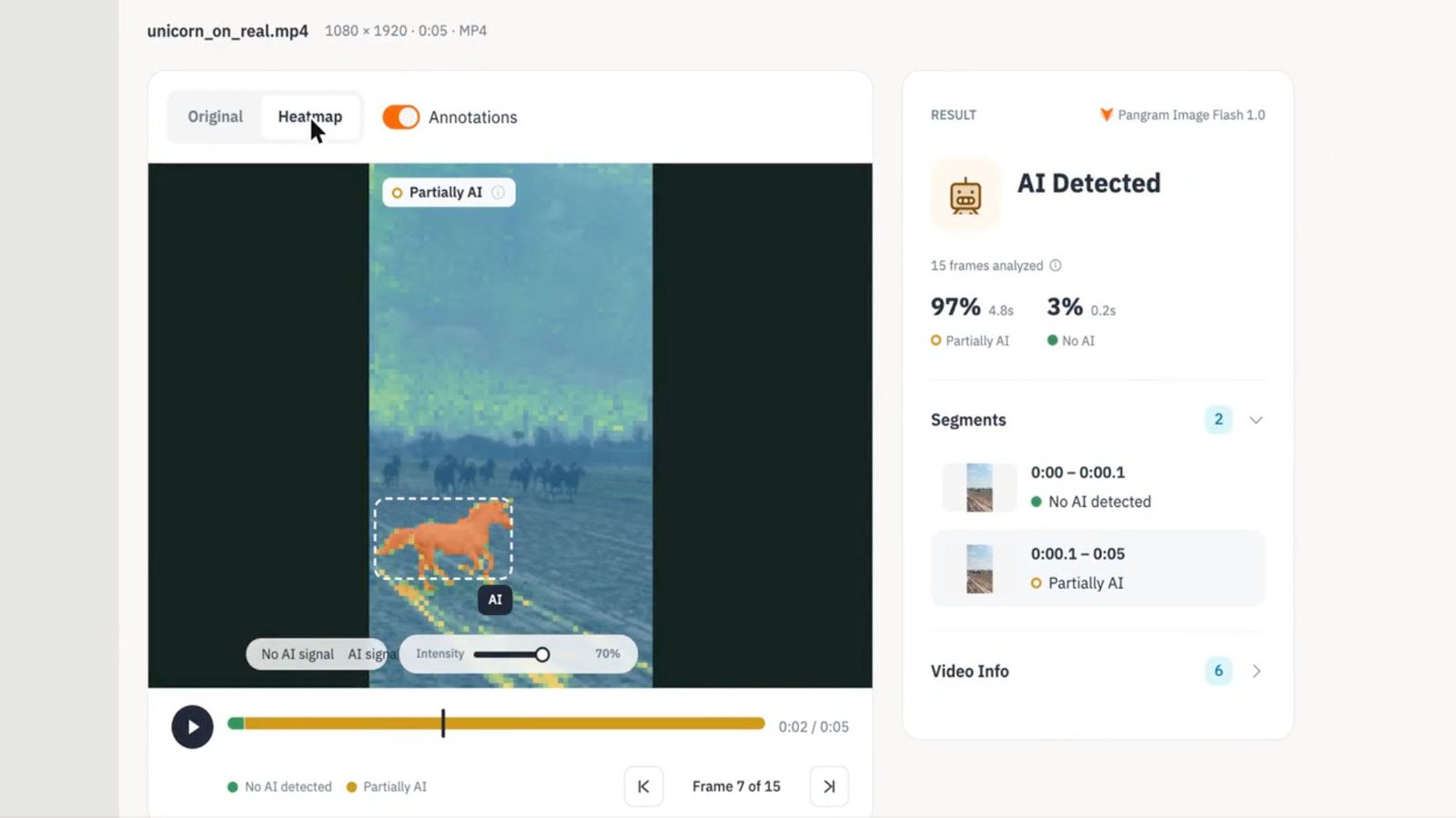
Pangram AI detection expands to video and images
Pangram AI detection capabilities are officially expanding, moving beyond their roots in text analysis to address the growing volume of synthetic visual content. The company has launched new tools designed to identify AI-generated video and image files, providing users with a way to navigate an increasingly complex media landscape. By integrating these features into their existing subscription model, they aim to provide a reliable filter for verifying the authenticity of digital clips.
How the model handles video and image analysis
The new video assessment tool allows subscribers to upload clips to determine if they were created or edited using generative models. According to the company, the system can differentiate between content that is partially AI-driven and clips that are entirely synthetic. A unique heatmap feature further assists by highlighting specific areas within a video that appear to be machine-generated. In internal testing, the model demonstrated over 98 percent accuracy in flagging frontier AI video content.
Meanwhile, the image analysis tools have moved from a research preview to a fully accessible Chrome extension. This update allows for automatic scanning of images while browsing the web. The company reports that its image model currently flags over 99 percent of AI-generated visuals with a notably low false-positive rate of just 0.27 percent. However, they advise that images smaller than 512 x 512 pixels may trigger a reduced confidence disclaimer.
Key performance metrics and limitations
- Video detection accuracy: Over 98 percent in internal tests.
- Image detection accuracy: Over 99 percent with a 0.27 percent false positive rate.
- Resolution requirements: Images under 512 x 512 pixels receive lower confidence scores.
- Availability: Included for all subscribers, with limited free trials available.
The Bottom Line on Pangram AI detection
The development of these tools was not without significant hurdles. CEO Max Spero noted that modern smartphone post-processing—such as the AI features found on the latest iPhone models—often mimics synthetic generation. The engineering team had to refine their model to ensure that legitimate photographs taken on high-end hardware were not incorrectly flagged as AI-generated. This required extensive testing on devices like the iPhone 18 Pro to ensure the software could distinguish between hardware-level image enhancement and full generative synthesis. As synthetic media becomes more prevalent, the effectiveness of Pangram AI detection will remain a critical factor for users verifying the source of their content.
For full official background and direct documentation, read the source coverage on Engadget.com Reporting.