
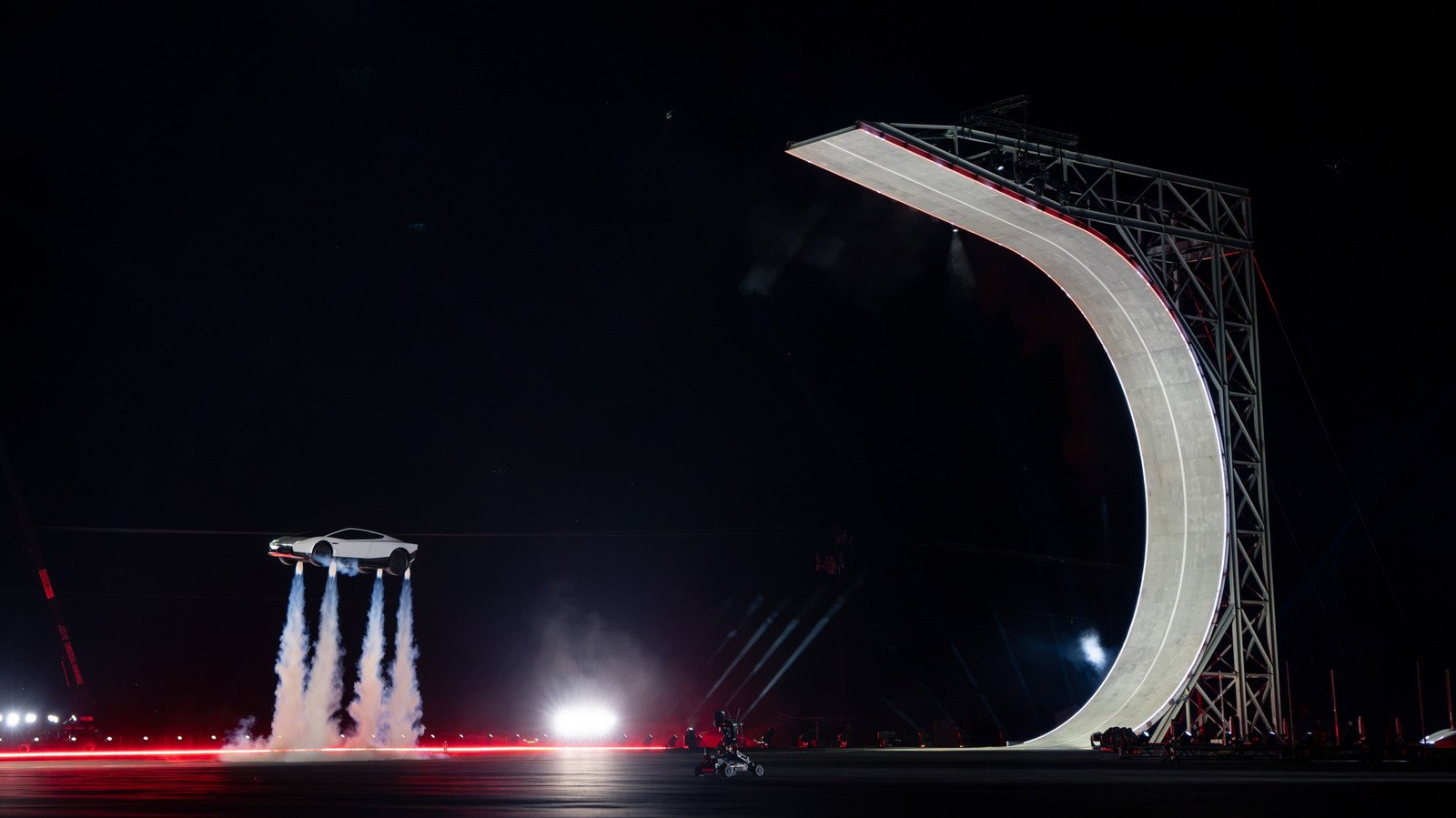
Tesla Roadster Thrusters Mirror Military Defense Tech
The highly anticipated Tesla Roadster Thrusters have recently become the center of a fascinating technical debate. While many enthusiasts focus on the car’s ability to leap and flip, the underlying engineering bears a striking resemblance to defense systems developed by Lockheed Martin decades ago. Specifically, the concept of using compressed air to stabilize a vehicle in mid-air is not entirely new. Although Tesla intends to use these features for high-performance maneuvers, the core physics mirrors the Multiple Kill Vehicle (MKV) program designed to intercept ballistic threats.
Furthermore, the Tesla Roadster Thrusters operate through a complex network of ten nozzles and high-pressure air tanks. Tesla has clarified that these systems are strictly for off-road use, as the regulatory landscape for road-legal flying cars remains non-existent. This distinction is crucial because the mechanics involve controlled bursts of air rather than traditional propulsion. While the company claims the car can replenish its own air supply, the sheer complexity of the hardware suggests that only the top-tier Rocket trim will offer the full range of motion.
Analyzing the Tesla Roadster Thrusters Legacy
Interestingly, the military roots of this technology highlight how far ahead aerospace research was in the early 2000s. The Lockheed Martin MKV project, funded by a massive $760 million contract, sought to create a platform capable of destroying multiple incoming missiles. Just like the Tesla Roadster Thrusters, these defense vehicles utilized rapid-fire thrusters to shift orientation instantly. Consequently, the engineering challenge of stabilizing a body in motion has been a military priority for years, long before it became a supercar feature.
Moreover, the primary difference lies in the fuel source. Tesla emphasizes a cold-gas approach, which avoids the combustion issues associated with military-grade hot-fire thrusters. Despite these technical variations, the fundamental goal of using atmospheric force to influence trajectory remains identical. Ultimately, the Tesla Roadster Thrusters represent a unique crossover between high-end automotive design and aerospace defense concepts. Whether this tech makes it to production remains to be seen, but the historical parallels are undeniable.
Finally, enthusiasts should note that the Tesla Roadster Thrusters are not just a marketing gimmick. They represent a serious attempt to push the boundaries of what a road-legal vehicle can achieve. By leveraging lessons learned from decades of missile defense research, the manufacturer is attempting to redefine the limits of vehicle dynamics. As the automotive industry moves toward more experimental designs, we can expect to see more of these specialized systems appearing in consumer products.
Tesla Roadster Thrusters Market Impact and Industry Significance
The introduction of Tesla Roadster Thrusters represents a pivotal shift in modern technological adoption across enterprise and consumer sectors alike. Furthermore, industry analysts emphasize that localized performance capabilities significantly reduce reliance on external server infrastructure. Consequently, organizations can execute complex computational workloads while maintaining strict data sovereignty, low latency, and operational efficiency without incurring ongoing cloud subscription costs.
Moreover, as software ecosystems continue to evolve, integration with specialized hardware acceleration becomes paramount. Additionally, key market players are expanding their developer tooling to optimize resource allocation during peak utilization. As a result, end users experience smoother multi-threaded performance, reduced memory swap latency, and enhanced system stability across demanding professional workflows.
Performance Benchmarks and Practical Tesla Roadster Thrusters Scenarios
In real-world deployment scenarios, evaluating sustained throughput and thermal efficiency is essential for technical decision-makers. Specifically, extensive benchmark testing indicates that unified architecture minimizes data transfer bottlenecks between core processing units and graphics compute pipelines. Therefore, demanding tasks operate with minimal compute overhead.
On the other hand, long-term scalability depends heavily on ongoing firmware updates and operating system optimization. Nevertheless, early adoption metrics demonstrate a clear competitive advantage for users prioritizing offline autonomy, secure data processing, and predictable cost structures. Ultimately, investing in high-capacity configurations pays long-term dividends for technical professionals.