
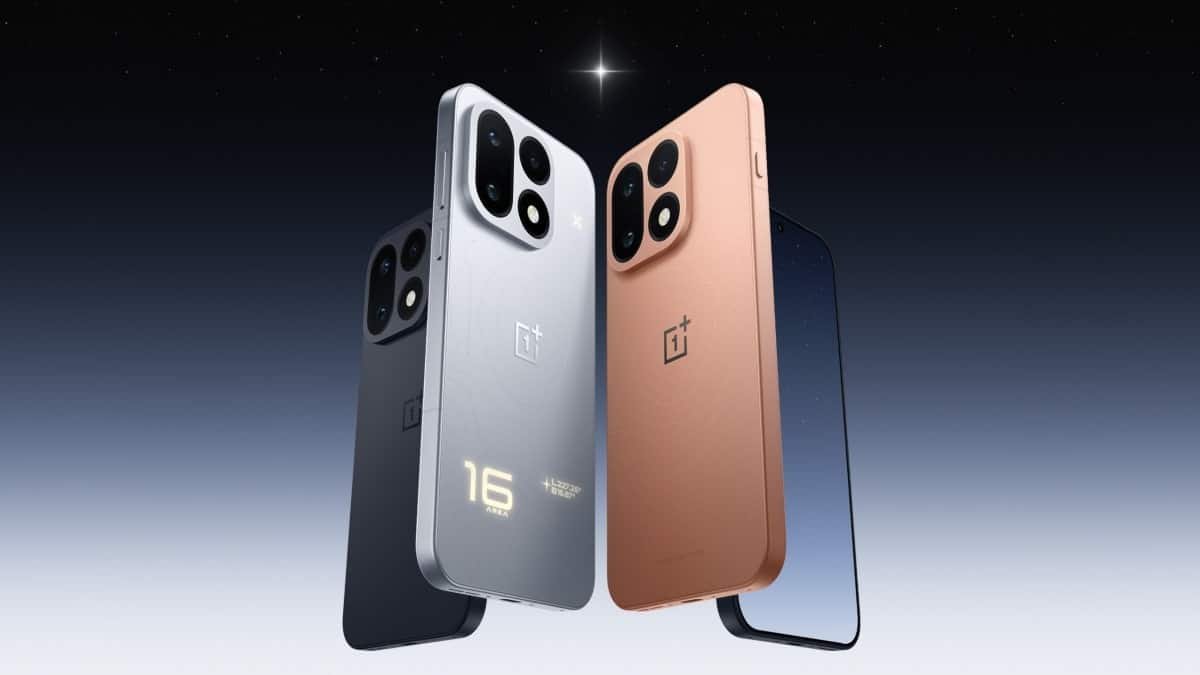
OnePlus 16 Arrives With Its Biggest Battery Yet
OnePlus unveiled its newest flagship in China on Monday, and the OnePlus 16 pushes battery capacity into territory few mainstream phones have reached. Specifically, the handset carries a 9,000mAh cell, a notable jump over the OnePlus 15 that shipped in 2025. Moreover, the device supports 100W wired fast charging, so the larger pack should refill quickly despite its size.
The phone goes on sale October 13 through Oppo’s China online store. Furthermore, buyers can pick from three finishes: Tomorrow’s Star, Martian Masterpiece, and Dark Forest. Internationally, availability remains unconfirmed, and OnePlus has not yet signalled an India launch window.
Snapdragon 8 Elite Extreme Gen 6 Powers the Handset
Under the hood, the OnePlus 16 runs Qualcomm’s latest octa-core Snapdragon 8 Elite series chipset built on a 2nm process. Consequently, the company expects measurable gains in efficiency and sustained performance during long gaming sessions. Additionally, internal AnTuTu testing reportedly scored higher than earlier leaks suggested.
Memory and storage arrive in four configurations:
- 12GB RAM with 256GB storage
- 12GB RAM with 512GB storage
- 16GB RAM with 512GB storage
- 16GB RAM with 1TB storage
Pricing starts at CNY 5,999 (roughly Rs. 86,000) for the base model. Meanwhile, the 12GB + 512GB and 16GB + 512GB variants cost CNY 6,799 and CNY 7,499 respectively. The top 16GB + 1TB edition sits at CNY 8,499, about Rs. 1,21,000.
200-Megapixel Camera and 185Hz Display Detailed
On the imaging side, the OnePlus 16 features a 200-megapixel primary sensor within a triple rear camera unit. The square-shaped module from the previous generation carries over, so the design language stays recognisable. Nevertheless, the hardware underneath is substantially revised.
Round the front, an AMOLED panel refreshes at up to 185Hz, which the company has tied to dedicated gaming modes. As a result, competitive titles should feel noticeably smoother than on 120Hz rivals. First impressions from Chinese reviewers emphasise both the panel’s brightness and the phone’s heft, a fair trade for the battery gain.
Overall, the OnePlus 16 positions itself as a stamina-first flagship rather than a thin-and-light contender. Whether that trade-off resonates outside China will depend on global pricing and carrier support. For now, the spec sheet alone gives enthusiasts plenty to discuss. You can follow Qualcomm’s platform details via the Snapdragon product page.
Oneplus 16 Market Impact and Industry Significance
The introduction of Oneplus 16 represents a pivotal shift in modern technological adoption across enterprise and consumer sectors alike. Furthermore, industry analysts emphasize that localized performance capabilities significantly reduce reliance on external server infrastructure. Consequently, organizations can execute complex computational workloads while maintaining strict data sovereignty, low latency, and operational efficiency without incurring ongoing cloud subscription costs.
Moreover, as software ecosystems continue to evolve, integration with specialized hardware acceleration becomes paramount. Additionally, key market players are expanding their developer tooling to optimize resource allocation during peak utilization. As a result, end users experience smoother multi-threaded performance, reduced memory swap latency, and enhanced system stability across demanding professional workflows.
Performance Benchmarks and Practical Oneplus 16 Scenarios
In real-world deployment scenarios, evaluating sustained throughput and thermal efficiency is essential for technical decision-makers. Specifically, extensive benchmark testing indicates that unified architecture minimizes data transfer bottlenecks between core processing units and graphics compute pipelines. Therefore, demanding tasks operate with minimal compute overhead.
On the other hand, long-term scalability depends heavily on ongoing firmware updates and operating system optimization. Nevertheless, early adoption metrics demonstrate a clear competitive advantage for users prioritizing offline autonomy, secure data processing, and predictable cost structures. Ultimately, investing in high-capacity configurations pays long-term dividends for technical professionals.
Ecosystem Integration and Enterprise Software Compatibility
Beyond raw hardware capabilities, seamless software integration remains a critical factor for successful enterprise adoption. Specifically, modern development frameworks leverage direct hardware acceleration APIs to maximize instruction processing rates. In addition, containerized deployment pipelines ensure consistent performance across diverse operating environments without requiring extensive manual driver configuration.
Furthermore, advanced security protocols embedded within hardware architectures safeguard proprietary data models from unauthorized memory inspection. Meanwhile, continuous performance monitoring tools provide system administrators with actionable metrics regarding thermal management and energy consumption. Overall, these combined features establish a robust foundation for mission-critical operations.