
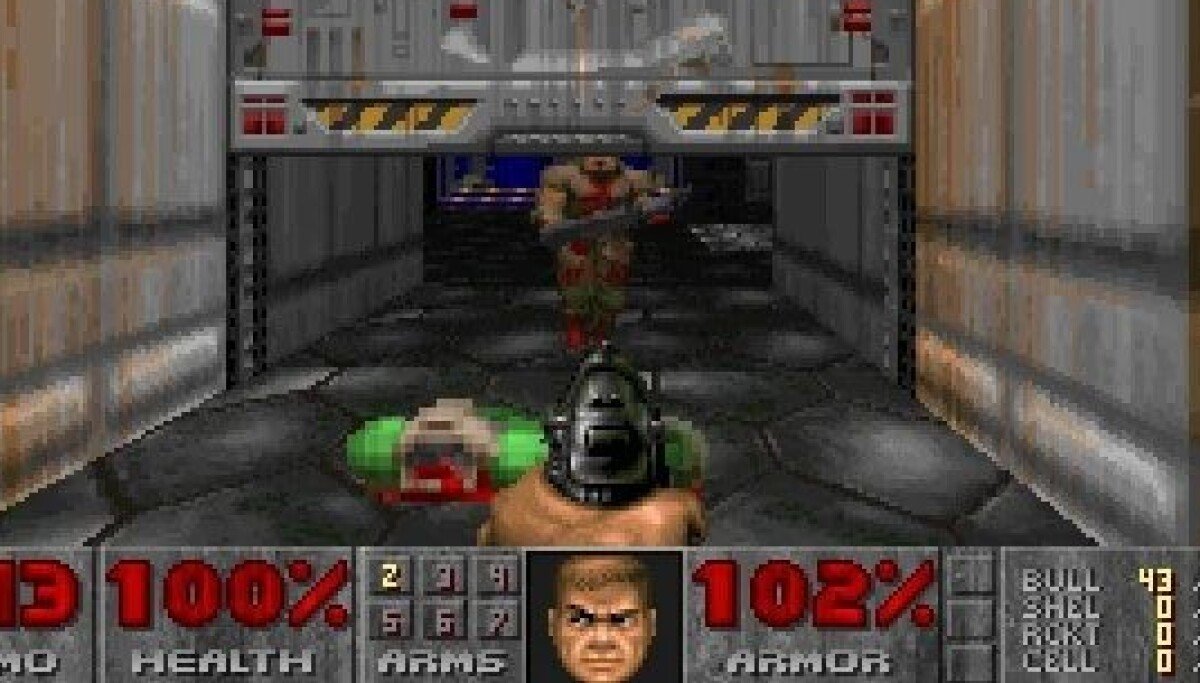
Doom on DNS Experiment Reveals System Constraints
A developer has successfully compiled the classic shooter Doom on DNS, transforming the internet’s naming infrastructure into a functional but agonizingly slow computer. The project demonstrates that domain name servers can store both data and executable logic, effectively turning DNS into a programmable database. However, the resulting performance makes even the original 1993 release feel lightning-fast by comparison.
Furthermore, the experiment began with a simple premise: DNS operates as a distributed database capable of storing arbitrary records. The developer realized that arithmetic operations and conditional branching could be encoded into DNS UPDATE requests, with responses serving as computational results. Each 32-bit addition requires four separate queries, while a single branch instruction demands five lookups. Consequently, rendering one game frame consumes approximately 6.6 million DNS transactions.
Technical Implementation Uses DNS UPDATE Records
The implementation leverages RFC 2136 dynamic update functionality to write and read register values across the naming hierarchy. A small userspace program acts as the clock and control unit, issuing queries to a BIND nameserver that performs the actual computation. Moreover, the developer packed multiple virtual registers into single DNS records to reduce query overhead, and implemented instruction pipelining to overlap lookups where possible.
Additionally, native DNS transport protocols were used instead of higher-level abstractions. UDP queries average 4 microseconds per round trip, while TCP connections require roughly 7 microseconds. These latencies appear trivial in isolation, but they compound catastrophically when millions of operations execute sequentially. The developer noted that cloud providers charging per DNS request would generate astronomical bills for even a few seconds of gameplay.
Performance Bottlenecks Emerge at Scale
Initial testing produced a frame time of 577 seconds after pressing a single movement key. Through aggressive optimization including lookahead execution and dense register packing, the developer reduced this to 146 seconds per frame. Nevertheless, the fundamental architecture imposes hard limits that no software optimization can overcome. The protocol simply was not designed for this workload.
Specifically, the lack of native arithmetic instructions in DNS means every calculation decomposes into multiple round trips. A traditional processor executes billions of instructions per second; this DNS-based system manages roughly 45,000 operations per second. For context, the original Doom engine required a 33 MHz 386 processor. The DNS computer operates at an effective frequency measured in hertz, not megahertz.
Doom on DNS Project Draws Pioneer Attention
After publishing the code, the developer contacted Paul Vixie, co-author of RFC 2136 and architect of BIND 8. Vixie reportedly described the project as “the best use of RFC 2136 DNS UPDATE” he had encountered. While complimentary, the acknowledgment underscores how far this implementation stretches the protocol’s intended purpose.
Ultimately, the Doom on DNS project serves as a striking demonstration of computational universality. Any system capable of storing state and performing conditional logic can theoretically execute arbitrary programs. However, the experiment also highlights why specialized computing architectures exist. The domain name system excels at its designed role: mapping human-readable names to network addresses. Asking it to render 3D graphics reveals the importance of purpose-built infrastructure. For more on DNS protocol specifications, see the RFC 2136 standard.
Doom On Dns Market Impact and Industry Significance
The introduction of Doom On Dns represents a pivotal shift in modern technological adoption across enterprise and consumer sectors alike. Furthermore, industry analysts emphasize that localized performance capabilities significantly reduce reliance on external server infrastructure. Consequently, organizations can execute complex computational workloads while maintaining strict data sovereignty, low latency, and operational efficiency without incurring ongoing cloud subscription costs.
Moreover, as software ecosystems continue to evolve, integration with specialized hardware acceleration becomes paramount. Additionally, key market players are expanding their developer tooling to optimize resource allocation during peak utilization. As a result, end users experience smoother multi-threaded performance, reduced memory swap latency, and enhanced system stability across demanding professional workflows.
Performance Benchmarks and Practical Doom On Dns Scenarios
In real-world deployment scenarios, evaluating sustained throughput and thermal efficiency is essential for technical decision-makers. Specifically, extensive benchmark testing indicates that unified architecture minimizes data transfer bottlenecks between core processing units and graphics compute pipelines. Therefore, demanding tasks operate with minimal compute overhead.
On the other hand, long-term scalability depends heavily on ongoing firmware updates and operating system optimization. Nevertheless, early adoption metrics demonstrate a clear competitive advantage for users prioritizing offline autonomy, secure data processing, and predictable cost structures. Ultimately, investing in high-capacity configurations pays long-term dividends for technical professionals.