
Claude Personal Finance Challenges ChatGPT Financial Tools
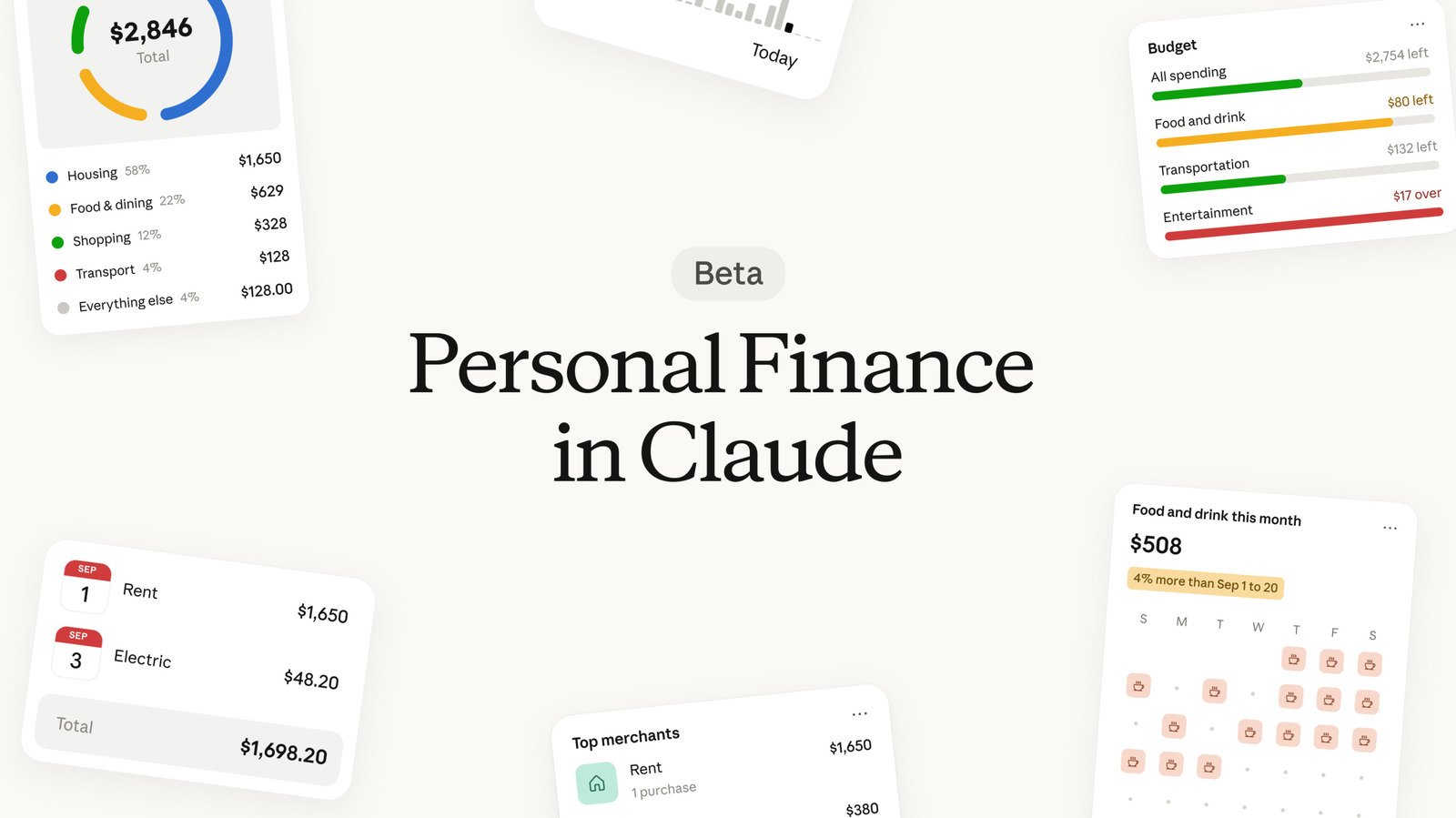
Anthropic has officially entered the banking space with the launch of Claude Personal Finance, a direct competitor to the existing financial management tools found within ChatGPT. As Anthropic prepares for a potential public offering, this new feature aims to help users visualize spending and savings, though the two giants take fundamentally different approaches to data privacy.
Both Claude Personal Finance and OpenAI’s counterpart rely on third-party integration via Plaid to connect with major institutions like Chase and Bank of America. Once connected, these systems provide read-only access, allowing the AI to pull transaction history and balance data without the ability to initiate transfers or payments. While the utility of these dashboards is largely similar, the underlying privacy frameworks represent a significant divergence in corporate philosophy.
Claude Personal Finance: Data Handling and Privacy Differences
The most critical distinction for users considering Claude Personal Finance involves how their data is treated. Anthropic has explicitly stated that conversations within their financial hub are not used to train their underlying models. Furthermore, if a user decides to disconnect their bank account, the company claims that the AI loses access to the previously provided financial data immediately.
In contrast, OpenAI treats financial inquiries similarly to standard chat interactions. By default, your data may be used to improve their models unless you manually navigate to the settings menu to opt out. This difference makes Claude Personal Finance a potentially more attractive option for privacy-conscious users who want to avoid the complexities of managing model training preferences for sensitive bank data.
What Users Can Expect from AI Budgeting
Both platforms offer a similar suite of features for those looking to organize their money. Users can generate visual dashboards to track monthly expenses, monitor investment portfolios, and identify spending habits. They also provide conversational assistance for financial planning, such as calculating savings goals for a new home or a large vacation. While neither is designed to replace professional financial advisors, they serve as automated assistants for daily money management.
- Read-only access: Both tools use Plaid to view data without executing transactions.
- Training settings: Claude excludes financial chats from model training by default.
- Data retention: OpenAI requires manual opt-outs to stop training on user data.
Ultimately, the choice between Claude Personal Finance and its rival comes down to your personal comfort level regarding data usage. If you prefer a “set it and forget it” privacy model, Anthropic’s approach provides a clearer security boundary. For those already integrated into the OpenAI ecosystem, the convenience of keeping financial data within the same platform may outweigh the extra steps required to secure your privacy settings.
For full official background and direct documentation, read the source coverage on Engadget.com Reporting.