
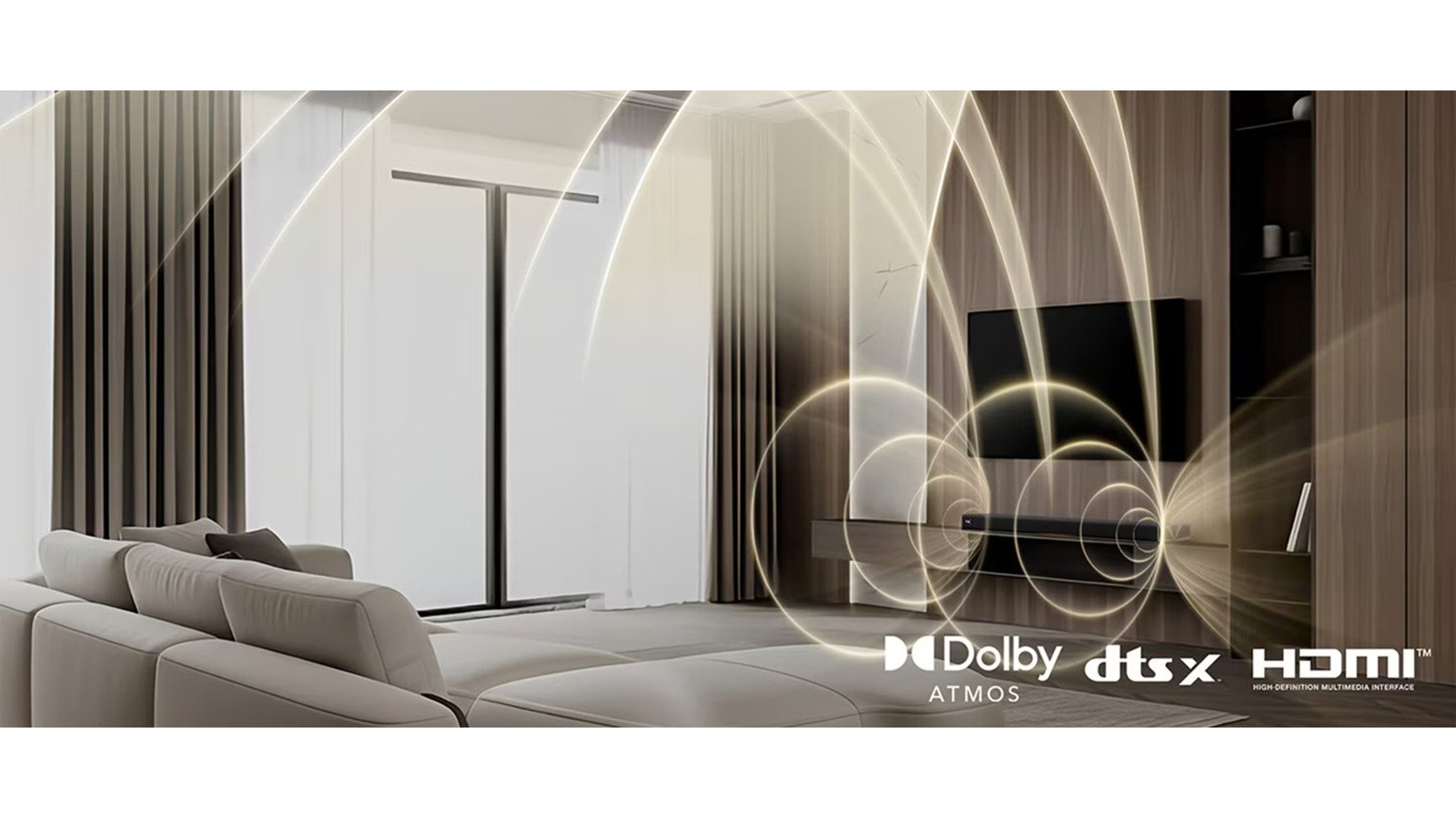
LG Sound Suite Expands Audio Capabilities With DTS:X
LG Sound Suite now supports DTS:X and Google Cast, giving home theater enthusiasts additional ways to enjoy immersive audio from compatible content. The premium modular system lets users pick and choose speakers à la carte to fit their space, then uses Dolby Atmos FlexConnect technology to optimize performance. Furthermore, the company teased a Media Connect Hub for DTS:X devices currently in development.
The key addition brings DTS:X support to the H7 soundbar, which serves as the centerpiece of LG Sound Suite. This feature provides home theater enthusiasts additional ways to enjoy multi-dimensional audio from compatible source devices. Additionally, Google Cast support on the H7 soundbar allows streaming music and podcasts directly to the system without intermediary steps.
Enhanced Network Flexibility and Bass Options
LG Sound Suite expands compatibility in networked environments with support for Wi-Fi 6 GHz networks and 5 GHz DFS channels. Consequently, users gain more stereo and multi-speaker configuration options within their setup. Moreover, the system now supports dual W7 subwoofer setups for those who want maximum low-end impact.
The Media Connect Hub promises to enable DTS:X from compatible external source devices and further expand access to DTS:X content. While details remain vague, this could connect Blu-ray or 4K Ultra HD disc players to the LG Sound Suite environment. Meanwhile, software updates are already rolling out in some regions, though timing varies by location.
Modular Approach Sets LG Sound Suite Apart
Unlike traditional soundbars, LG Sound Suite employs a modular philosophy where speakers can be placed anywhere in the room. Dolby Atmos FlexConnect then calibrates the system automatically. This approach appeals to enthusiasts who want premium audio without permanent installation constraints.
For more details on DTS:X technology, visit the official DTS:X page. The combination of flexible placement, expanded codec support, and wireless streaming makes LG Sound Suite a compelling option for serious home theater builders.
Lg Sound Suite Market Impact and Industry Significance
The introduction of Lg Sound Suite represents a pivotal shift in modern technological adoption across enterprise and consumer sectors alike. Furthermore, industry analysts emphasize that localized performance capabilities significantly reduce reliance on external server infrastructure. Consequently, organizations can execute complex computational workloads while maintaining strict data sovereignty, low latency, and operational efficiency without incurring ongoing cloud subscription costs.
Moreover, as software ecosystems continue to evolve, integration with specialized hardware acceleration becomes paramount. Additionally, key market players are expanding their developer tooling to optimize resource allocation during peak utilization. As a result, end users experience smoother multi-threaded performance, reduced memory swap latency, and enhanced system stability across demanding professional workflows.
Performance Benchmarks and Practical Lg Sound Suite Scenarios
In real-world deployment scenarios, evaluating sustained throughput and thermal efficiency is essential for technical decision-makers. Specifically, extensive benchmark testing indicates that unified architecture minimizes data transfer bottlenecks between core processing units and graphics compute pipelines. Therefore, demanding tasks operate with minimal compute overhead.
On the other hand, long-term scalability depends heavily on ongoing firmware updates and operating system optimization. Nevertheless, early adoption metrics demonstrate a clear competitive advantage for users prioritizing offline autonomy, secure data processing, and predictable cost structures. Ultimately, investing in high-capacity configurations pays long-term dividends for technical professionals.
Ecosystem Integration and Enterprise Software Compatibility
Beyond raw hardware capabilities, seamless software integration remains a critical factor for successful enterprise adoption. Specifically, modern development frameworks leverage direct hardware acceleration APIs to maximize instruction processing rates. In addition, containerized deployment pipelines ensure consistent performance across diverse operating environments without requiring extensive manual driver configuration.
Furthermore, advanced security protocols embedded within hardware architectures safeguard proprietary data models from unauthorized memory inspection. Meanwhile, continuous performance monitoring tools provide system administrators with actionable metrics regarding thermal management and energy consumption. Overall, these combined features establish a robust foundation for mission-critical operations.