
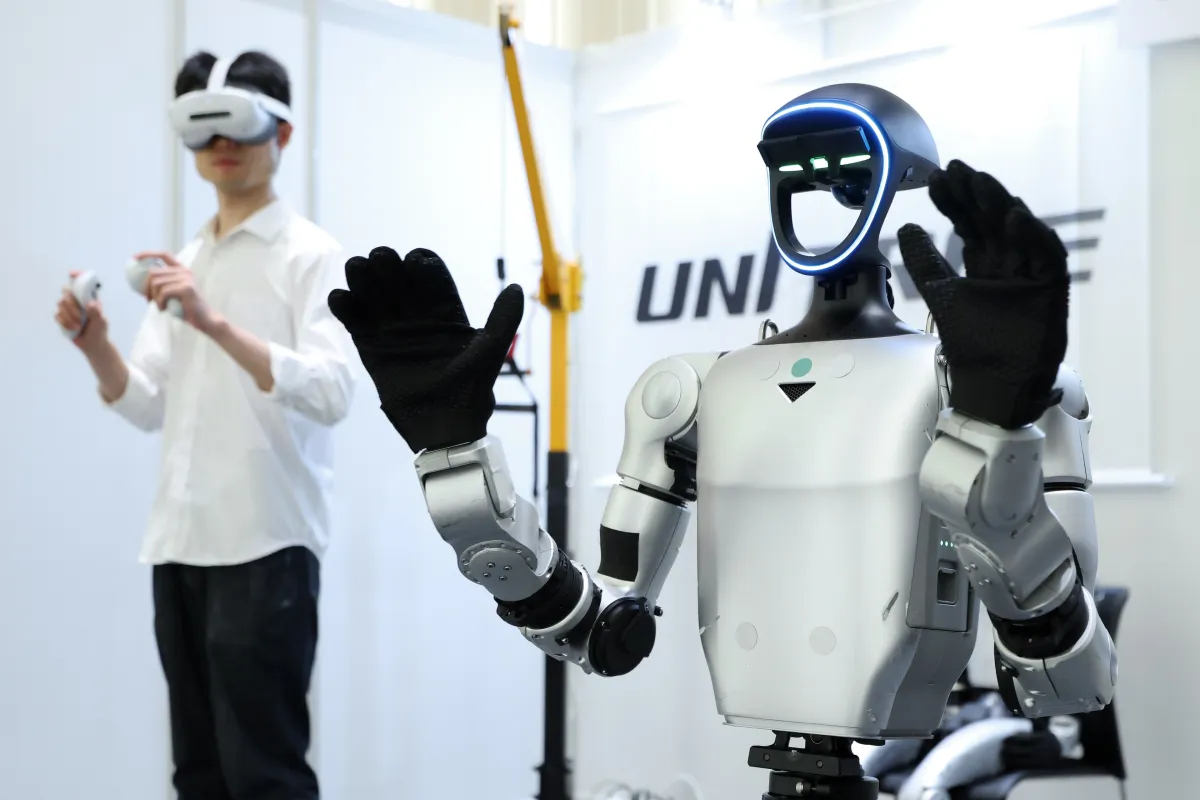
The Gap Between Digital Intelligence and Physical Action
The core tension in current AI discourse lies in the belief that Large Language Models (LLMs) can be directly transplanted into robotic bodies to achieve immediate autonomy. Amulya Vishwanath, a former NVIDIA robotics lead and current managing partner at Techable VC, suggests this view is dangerously reductive. In her assessment, the industry is currently fixated on scaling intelligence while ignoring the profound difficulty of scaling physical reliability.
Unlike a chatbot that can hallucinate a minor error without catastrophic consequences, a physical robot operating in a warehouse or laboratory must obey the laws of physics. If a robotic hand miscalculates the pressure required to grip a fragile vial, the result is physical destruction, not just a coherent but incorrect sentence. Vishwanath argues that we are currently in an era of experimentation, similar to the early days of personal computing where components were modular, incompatible, and difficult to standardize.
Why Hardware Foundations Outpace Software Scaling
Vishwanath’s perspective is informed by seven years at the center of the NVIDIA robotics ecosystem. She highlights that even if an AI model becomes infinitely intelligent, the physical interface—the actuators, sensors, and power systems—remains the primary bottleneck. The industry is currently rebuilding these foundational components from scratch to support modern machine learning.
General Intuition CEO Pim de Witte has previously floated the idea that general-purpose foundation models might eventually render specialized robotics programming obsolete. Vishwanath’s counter-argument is centered on structural utility. She posits that while software is agile, mechanical hardware requires rigorous safety testing that cannot be accelerated by simply adding more GPU compute power. The “ChatGPT moment” for physical AI cannot occur until the latency between digital cognition and physical movement is near zero, and the hardware can withstand the wear and tear of autonomous, 24/7 operation.
Investment Shifts Toward Material Science and Robotics
Transitioning from a high-level executive at a tech giant to the founder of Techable VC, Vishwanath has reoriented her focus toward deep-tech investments. Her firm actively avoids the “hype cycle” that often dominates AI discourse, choosing instead to target companies that are solving foundational issues in three specific domains:
- Advanced Robotics: Developing modular hardware that allows AI models to interface with the real world without requiring custom coding for every motion.
- Materials Science: Creating stronger, lighter, and more conductive components that allow robots to operate longer on a single charge.
- Life Sciences: Integrating autonomous machinery into laboratory environments to accelerate drug discovery and genetic sequencing.
This strategy reflects a departure from the “move fast and break things” mentality that defined the digital software era. In physical AI, breaking things is an expensive, non-scalable failure point that discourages enterprise adoption.
Challenges in Scaling Physical AI Systems
Comparing text-based AI to physical robotics is a common oversight among investors and analysts. The following table outlines the critical differences that define the current development bottleneck in the industry.
| Characteristic | Generative Language Models | Physical AI (Robotics) |
|---|---|---|
| Primary Bottleneck | Data availability and Compute | Hardware reliability and Latency |
| Failure Consequence | Hallucinated output | Physical damage or injury |
| Development Stage | Mature/Scaling phase | Foundational/Assembly phase |
| Standardization | High (APIs, Python) | Low (Fragmented protocols) |
The Gender Perspective in Enterprise Tech Leadership
Beyond her technical market analysis, Vishwanath’s career trajectory offers a roadmap for executive leadership in the venture space. As one of the first women executives to successfully spin out of NVIDIA to launch an independent early-stage investment firm, her experience underscores the importance of domain expertise in venture capital. She argues that the lack of diversity in deep-tech leadership often leads to a homogenous view of what constitutes a “breakthrough.” By bringing a background in robotics-specific product marketing to the venture side, she is positioning Techable VC to identify technical feasibility that generalist firms often overlook.
Frequently Asked Questions
Why does Amulya Vishwanath say physical AI lacks a ChatGPT moment?
She argues that robotics is constrained by mechanical, physical, and safety-related limitations that do not exist in purely digital software environments. While LLMs can iterate through software, physical AI requires reliable hardware, standardized actuators, and real-world safety testing, which cannot be accelerated by scaling compute alone.
What is the “Lego era” of robotics mentioned by industry experts?
The “Lego era” refers to the current stage of robotics where components, software stacks, and hardware interfaces are modular and highly fragmented. Like early construction sets, developers must spend significant time connecting incompatible parts, meaning the industry has not yet achieved a unified, standardized platform for intelligence.
How does Techable VC evaluate potential AI investments?
The firm prioritizes structural utility over fleeting market hype. They focus on foundational advancements in robotics, materials science, and life sciences—areas where the technology provides a clear, scalable solution to a physical problem rather than simply attempting to apply language models to every use case.
Next Steps for Investors and Tech Observers
For those monitoring the robotics sector, the immediate path forward is not found in the latest chatbot release, but in the laboratory. Future breakthroughs will likely arrive in the form of improved battery density, more responsive haptic feedback systems, and safer, more collaborative robotic limbs. Investors and tech enthusiasts should shift their attention away from pure software benchmarks and toward firms making capital-intensive investments in the physical infrastructure that will ultimately house the next generation of AI. Tracking the maturation of sensor-to-actuator latency will provide a more accurate indicator of industry progress than any hype-driven narrative.