
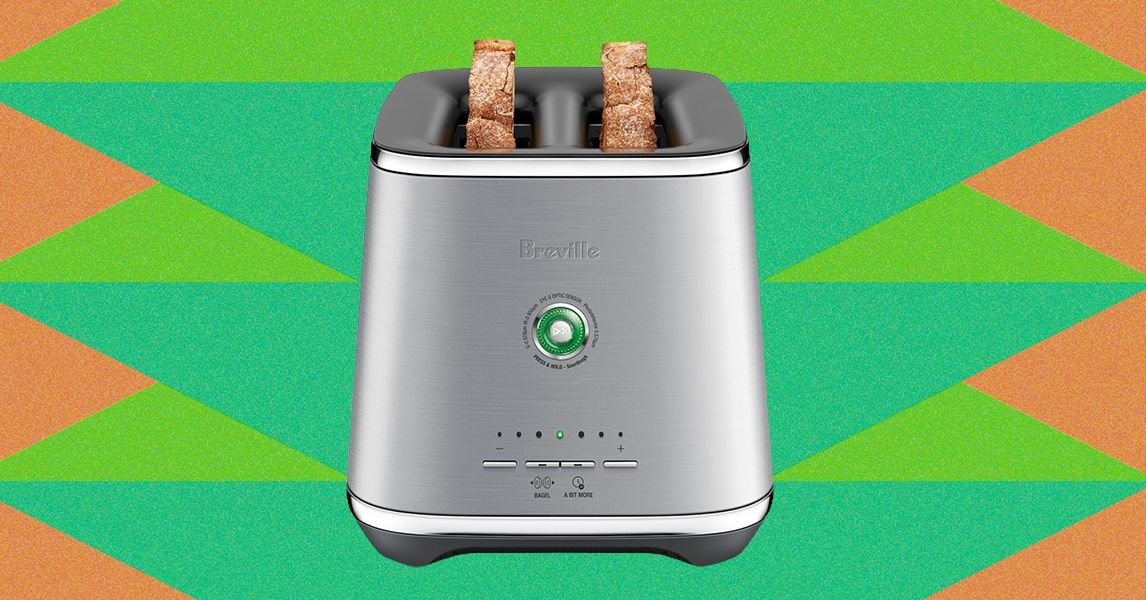
Breville Eye Q Toaster Brings Optical Scanning to Breakfast
The Breville Eye Q Toaster arrives on countertops with a party trick: laser-green lights blinking rapidly inside the left slot, scanning your bread ten times every second. This optical approach replaces the traditional timer dial, promising toast that stops exactly when the target shade is reached. Priced at $300 for the two-slice 850 Auto model and $400 for its four-slot sibling, the appliance targets buyers who want precision without guesswork.
Breville divides doneness into seven progressively darker levels, stopping short of a full ten perhaps because anything beyond seven edges toward carbon. The sensors first read the bread’s initial color, then toast until the surface reaches a darker threshold matching your selection. Furthermore, a dedicated “A bit more” button adds a final burst if the first cycle falls short.
Specialized Modes Handle Sourdough and Frozen Items
Hold the start button for two seconds and the Breville Eye Q Toaster enters sourdough mode, which keeps the center slightly lighter to protect crust edges that burn faster. Press twice quickly and it switches to a classic timer mode, recommended for Pop-Tarts and frozen waffles. Notably, there is no separate frozen button; the sensors simply continue until the target darkness arrives, regardless of starting temperature.
Design details include a looped plug that reduces cord strain and a rear channel that hides the cable neatly. The crumb tray slides out with generous capacity, making cleanup straightforward. For a deeper look at optical sensing in consumer appliances, see this IEEE overview of sensor applications.
Verdict: High-Tech Toast With Minor Quirks
The Breville Eye Q Toaster delivers consistent results and a satisfying user experience, though the light show may feel excessive for a simple breakfast task. Buyers who value repeatable browning and thoughtful ergonomics will appreciate the engineering. Meanwhile, traditionalists may prefer a $30 mechanical timer that does the job without lasers.
Breville Eye Q Toaster Market Impact and Industry Significance
The introduction of Breville Eye Q Toaster represents a pivotal shift in modern technological adoption across enterprise and consumer sectors alike. Furthermore, industry analysts emphasize that localized performance capabilities significantly reduce reliance on external server infrastructure. Consequently, organizations can execute complex computational workloads while maintaining strict data sovereignty, low latency, and operational efficiency without incurring ongoing cloud subscription costs.
Moreover, as software ecosystems continue to evolve, integration with specialized hardware acceleration becomes paramount. Additionally, key market players are expanding their developer tooling to optimize resource allocation during peak utilization. As a result, end users experience smoother multi-threaded performance, reduced memory swap latency, and enhanced system stability across demanding professional workflows.
Performance Benchmarks and Practical Breville Eye Q Toaster Scenarios
In real-world deployment scenarios, evaluating sustained throughput and thermal efficiency is essential for technical decision-makers. Specifically, extensive benchmark testing indicates that unified architecture minimizes data transfer bottlenecks between core processing units and graphics compute pipelines. Therefore, demanding tasks operate with minimal compute overhead.
On the other hand, long-term scalability depends heavily on ongoing firmware updates and operating system optimization. Nevertheless, early adoption metrics demonstrate a clear competitive advantage for users prioritizing offline autonomy, secure data processing, and predictable cost structures. Ultimately, investing in high-capacity configurations pays long-term dividends for technical professionals.
Ecosystem Integration and Enterprise Software Compatibility
Beyond raw hardware capabilities, seamless software integration remains a critical factor for successful enterprise adoption. Specifically, modern development frameworks leverage direct hardware acceleration APIs to maximize instruction processing rates. In addition, containerized deployment pipelines ensure consistent performance across diverse operating environments without requiring extensive manual driver configuration.
Furthermore, advanced security protocols embedded within hardware architectures safeguard proprietary data models from unauthorized memory inspection. Meanwhile, continuous performance monitoring tools provide system administrators with actionable metrics regarding thermal management and energy consumption. Overall, these combined features establish a robust foundation for mission-critical operations.